
When we talk about cybersecurity incidents, the image that usually comes to mind is quite clear: hackers, malware, ransomware, or sophisticated attacks capable of compromising systems from the outside. However, not all serious problems start that way.
Sometimes, the risk doesn’t come from outside.
Sometimes, the problem is already inside, hidden in a programming error, a bad configuration, or a fault that goes unnoticed for too long.
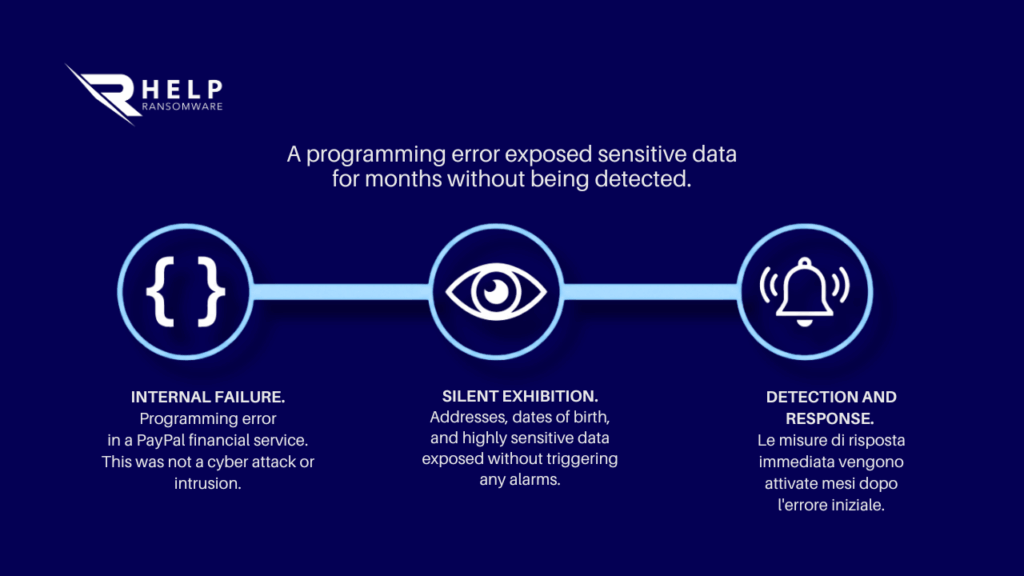
That’s precisely what the recent PayPal incident highlights. According to published reports, an internal flaw in one of its financial services allowed sensitive data to be exposed for several months before being detected. There was no confirmed external attack or sophisticated cybercrime campaign. No external breach was necessary.
And yet, there was exposure of highly sensitive information, a potential risk of fraud, and a need to activate immediate response measures.
These types of cases force us to look at cybersecurity from a different perspective. Because often the problem isn’t how an incident starts, but what that incident allows afterward.
When the risk does not come from an attacker
There’s a fairly common tendency to associate digital security exclusively with external threats. Targeted attacks, malware campaigns, credential theft, and complex intrusions usually dominate the conversation.
But the reality is much more uncomfortable.
Some serious incidents do not begin with an attacker, but with an internal failure that no one detects in time.
In the PayPal case, the origin of the problem was not a sophisticated offensive, but a programming error that affected a specific service and allowed the exposure of personal data for months.
This detail completely changes the interpretation of the incident.
Because when there is no visible attacker, many organizations tend to think the risk is lower. But in terms of impact, that’s not necessarily true.
If a failure exposes sensitive data, the consequences can be as serious as in many other cases. Cybercrimes associated with external attacks.
Cybersecurity isn’t just about stopping attacks. It’s also about preventing mistakes from becoming silent vulnerabilities.
When the problem is not the failure, but the information it leaves exposed
Here is one of the keys to this case.
Not all incidents pose the same level of risk. It all depends on the type of information compromised.
In this case, it wasn’t just administrative data or secondary information. It involved addresses, dates of birth, and other particularly sensitive data that could later be used for other forms of fraud.
And this is what completely changes the analysis.
A technical fault can be corrected.
A data breach, not always.
Once information is compromised, the risk shifts from the system itself to the use that third parties may make of that data.
The silent risk of a data breach
One of the most common mistakes when analyzing this type of incident is thinking that the problem ends when the fault is corrected.
In reality, many times the problem starts there.
The data presented does not necessarily have to be used immediately. It could become the basis for future fraud, impersonation, or identity theft campaigns.
Seemingly simple information can be used to construct much more credible messages, reinforcing attacks on Phishing or facilitating financial fraud.
Therefore, the Protecting company data and sensitive information is not just a technical issue. It’s a matter of future risk.
Often, the true impact of an exposure is not measured at the moment it occurs, but months later.
What starts as a mistake can end up being something else.
One of the biggest mistakes when talking about cybersecurity is to analyze each incident as if it were independent.
But the reality is different.
A single instance of access, exposure, or compromising information can become the first step in something much bigger.
That is precisely what is observed in many Ransomware hackers employ tactics where the visible attack is not the beginning, but rather the final stage of a chain of prior actions. Ransomware rarely appears immediately.
This is usually preceded by access, information gathering, internal movement, or taking advantage of small errors that seemed unimportant.
This is something that is analyzed very well in the anatomy ransomware attack.
The danger isn’t always the big attack.
The danger is the small mistake that no one considered important.
When the crisis is not technical, but reputational
Many organizations still measure the impact of an incident in technical terms: systems affected, data compromised, or recovery time.
But that’s only part of the problem.
On financial platforms like PayPal, the real damage can lie elsewhere: in trust. When a user discovers that sensitive information has been exposed, even if the number of those affected is limited, perceptions change.
The question is no longer what happened.
The question is: can I continue to trust?
The impact that doesn’t always appear in the reports
Loss of trust is one of the most difficult things to repair.
And that connects directly with what is analyzed in cyber risks and reputational impact.
An incident can be resolved technically and still continue to have consequences for a long time.
Because reputation cannot be restored with a patch.
It recovers with credibility.
The real lesson of the PayPal case
The PayPal case offers a lesson that goes far beyond a specific breach.
It demonstrates that cybersecurity is not just about stopping external attackers.
It also involves detecting internal errors, correcting them quickly, and understanding that a seemingly small mistake can have very real consequences.
This is especially important at a time when Statistics on cyberattacks continue to grow, and where many Companies affected by ransomware discover that the problem started long before the visible attack.
Sometimes, even with something seemingly minor.
Because in cybersecurity, the problem often doesn’t start when someone attacks. It starts when something is left exposed without anyone noticing.