
The growth of artificial intelligence in the business world has coincided with a steady increase in cyber risks. This technological transformation has created new opportunities for innovation, but it has also exposed organizations to emerging threats.
In this environment, data poisoning has become a critical threat to organizations that train, fine-tune, or connect artificial intelligence models to corporate information. Its objective is subtle: to contaminate the data that AI systems use to learn, classify, recommend, or respond.

Expert Ransomware Removal
Our certified professionals have over 25 years of experience in ransomware removal, data recovery, and computer security.
When company data is incorporated into artificial intelligence models without adequate controls, any alteration can directly affect the quality of their decisions.
The model may make incorrect decisions that appear accurate, creating a direct risk for CISOs, IT leaders, legal departments, compliance teams, and executive boards.
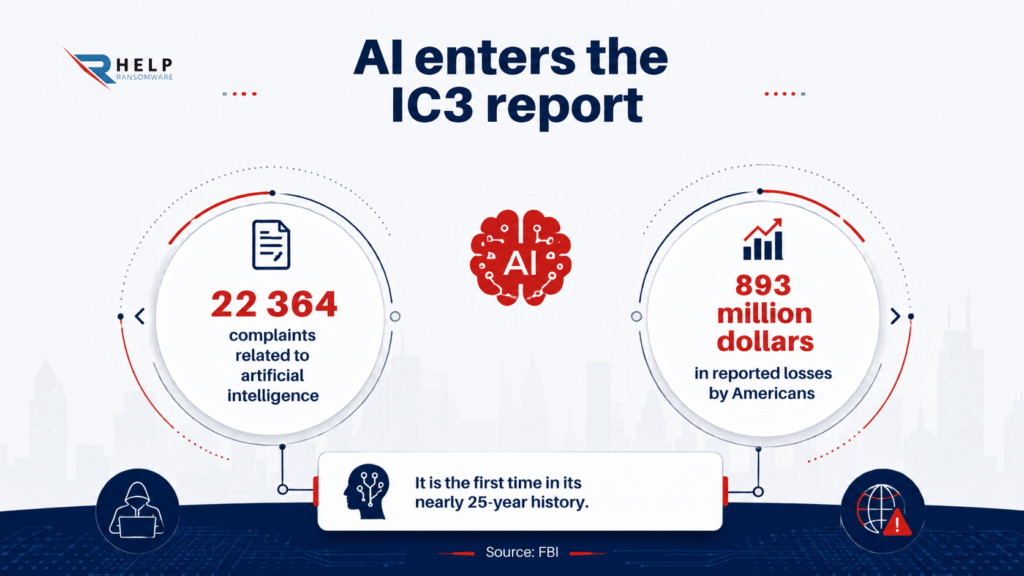
This concern is not theoretical. According to the FBI, internet-enabled crimes generated nearly $21 billion in reported losses in the United States in 2025. The agency also received more than one million complaints, with AI-related cases among the costliest.
What Is Data Poisoning?
Data poisoning is the intentional manipulation of the data used by an artificial intelligence system during its training, fine-tuning, updating, or query processes.
OWASP defines it as an attack in which a threat actor manipulates training data to cause unintended model behavior. In LLM-based applications, OWASP also warns that poisoning can affect pre-training data, fine-tuning datasets, or embeddings, introducing vulnerabilities, bias, or backdoors.
The risk is particularly serious because it compromises model integrity. When a company feeds contaminated data into an AI system, the model may learn false patterns and subsequently apply them to real-world processes.
For this reason, data poisoning should be addressed as part of an advanced cybersecurity strategy for businesses, especially when AI models are involved in critical decision-making.
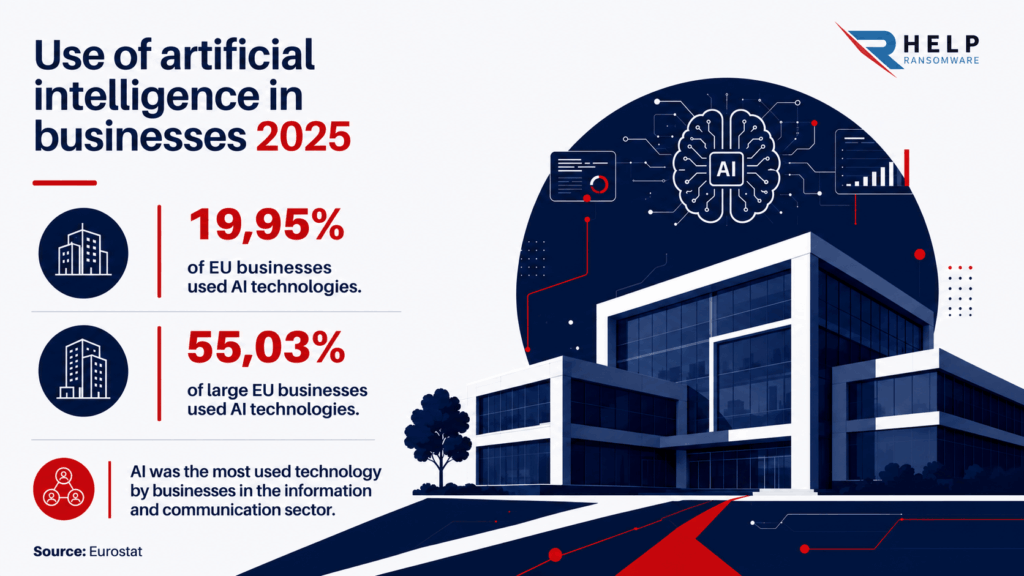
Why Data Corruption Is a Growing Concern for Companies That Use AI
Many organizations no longer use AI exclusively for internal testing. They are integrating it into corporate assistants, analytics systems, document processing engines, customer service platforms, automation tools, and security solutions.
Each integration expands the attack surface because every data source can become a contamination point, including public repositories, internal databases, third-party vendors, support tickets, logs, forms, and user-generated content.
In 2025, NIST published its report Adversarial Machine Learning: A Taxonomy and Terminology of Attacks and Mitigations, which categorizes attacks against machine learning systems according to their lifecycle stage, the attacker’s objectives, and potential mitigation measures.
This taxonomy confirms that AI security requires dedicated controls rather than relying exclusively on traditional protections for networks, servers, and endpoints.
How a Data Poisoning Attack Works
A data poisoning attack can occur at different stages of the AI lifecycle. In models trained from scratch, the attacker attempts to insert manipulated samples into the training dataset.
In models customized for a specific company, the attacker may contaminate the dataset used for fine-tuning. For retrieval-augmented generation systems, commonly known as RAG systems, the attacker may alter documents, knowledge bases, or embeddings that the model consults when generating responses.
This scenario is particularly relevant for companies using internal chatbots, document copilots, or assistants connected to policies, contracts, technical manuals, and customer data.
When a manipulated file enters a knowledge base, the AI system may treat it as a trusted source and generate inaccurate responses in operational, legal, or customer service processes.
The United Kingdom’s NCSC warns that data poisoning attacks occur when a threat actor alters the data used to train a model to produce undesirable outcomes, both from a security and bias perspective.
The agency also states that these risks will grow as LLMs are increasingly used to transfer data to third-party applications and services.
Types of Data Poisoning
Data poisoning attacks do not always pursue the same objective. In indiscriminate poisoning, the attacker seeks to degrade the model’s overall performance.
An AI-powered fraud detection system could begin approving suspicious transactions, a document management tool could misclassify confidential information, or a support system could recommend incorrect actions.
In targeted poisoning, the attacker seeks to produce a specific outcome. The model may function correctly in most situations but fail when a particular condition is present.
Another type is backdoor poisoning, in which a hidden trigger is inserted to activate malicious behavior only when a specific pattern appears.
This method is particularly dangerous because it can remain dormant for an extended period without affecting the system’s overall performance.
These risks demonstrate the need to protect not only the model itself but also the data sources and processes that feed it.

Immediate Ransomware Help
Don’t let ransomware hold your business hostage. Our experts are ready to recover your data and secure your systems.
Cases and Research Recognized by Government Agencies
Although data poisoning may appear to be a new threat, government cybersecurity agencies have been warning about its potential impact for years.
The NCSC cites the Tay chatbot case as an example of degradation caused by contaminated data. It also warns that poisoned datasets can reduce model performance or introduce targeted backdoors.
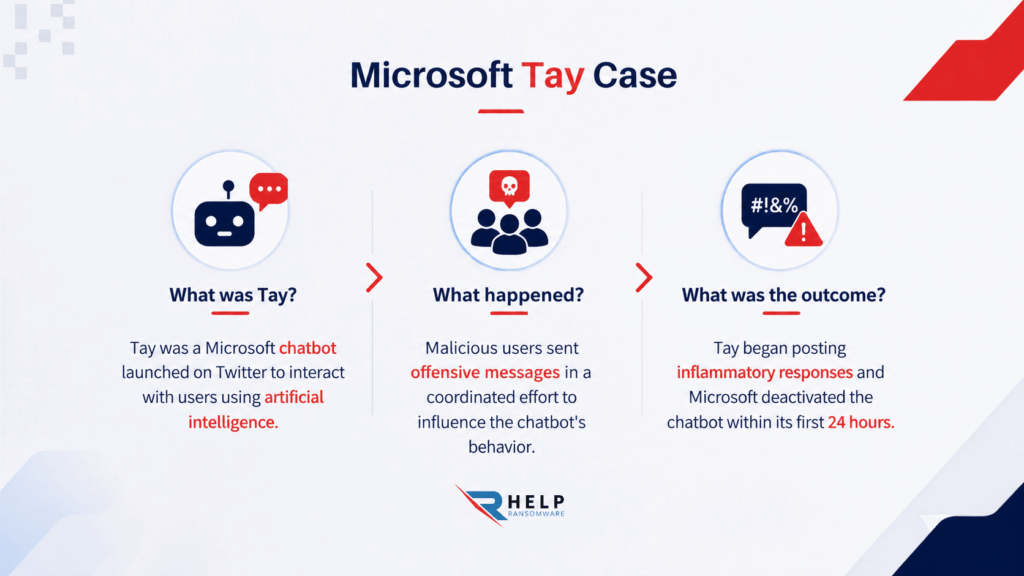
Cases like this demonstrate that the problem is not limited to research laboratories. When a system learns from external interactions, open data, or unverified documentation, it may incorporate malicious information.
For companies, the key question is not simply whether the model is advanced, but whether the data feeding it is verifiable, traceable, and controlled.
Business Impact of Data Poisoning
The business impact of data poisoning depends on how a company uses artificial intelligence. In finance, it can alter risk assessment or fraud detection models. In human resources, it can introduce bias into candidate screening processes.
For legal and compliance departments, it can lead to incorrect interpretations of internal policies. In customer service, it can generate inaccurate responses that damage the company’s reputation.
The impact can be particularly critical in cybersecurity. An AI-powered solution that analyzes logs, network traffic, or user behavior may stop detecting indicators of compromise. This could facilitate lateral movement, privilege escalation, data exfiltration, or preparations for a ransomware attack.
The connection to cybercrime is direct: manipulating the data used by intelligent systems can become a form of fraud, digital sabotage, or technical concealment before a larger intrusion.
Data Poisoning and Ransomware: An Increasingly Important Connection
Modern ransomware does not rely exclusively on encryption. Attackers combine social engineering, credential theft, vulnerability exploitation, data exfiltration, and reputational pressure.
Data poisoning can serve as a preliminary stage designed to weaken AI-based defenses. If an attacker manages to contaminate the data used by a detection tool, they may reduce its ability to identify malicious patterns.
Attackers could also introduce noise into alerts, alter risk priorities, or compromise the knowledge bases used by security analysts. The organization would continue relying on a system that appears to be functioning correctly, even though its defensive capabilities have been degraded.
The FBI recommends reporting ransomware attacks to the IC3 and states that it does not support paying ransoms, as payment does not guarantee data recovery and may encourage further attacks.
The agency also recommends keeping software up to date, using antimalware solutions, maintaining backups, and implementing business continuity plans.
How to Prevent Data Poisoning
Preventing data poisoning requires a combination of data governance, AI security, and incident response. The first step is to create an inventory of the models, datasets, embeddings, and data sources used by the organization. Every dataset should have a designated owner, purpose, version, date of incorporation, and documented controls.
Organizations should also restrict who can modify critical sources, implement automated validation processes, review data obtained from third parties, detect statistical anomalies, and maintain clean copies of important datasets.
This approach helps identify suspicious changes before contaminated data reaches the model and affects its decisions.
Specific Controls for RAG Systems and Regulatory Compliance
In RAG systems, organizations should control which documents enter the knowledge base, how those documents are updated, and which permissions are granted to users, vendors, and integrations.
These environments are particularly sensitive because the model generates responses based not only on its previous training but also on corporate documents that may change frequently.
The European Union Artificial Intelligence Act imposes obligations on providers and deployers of AI technologies and regulates the authorization and availability of artificial intelligence systems within the EU single market.
These regulatory requirements reinforce the importance of data quality as a central element of AI security.
For companies, preventing data poisoning is not merely a technical concern. It is also an essential practice for regulatory compliance, traceability, and the responsible management of intelligent systems.
Best Practices for CISOs and IT Leaders
Companies that use AI in cybersecurity should treat their models as critical assets. This means documenting their entire lifecycle, controlling their data sources, evaluating vendors, recording changes, testing model behavior against anomalous inputs, and establishing clear thresholds for reviewing or withdrawing a model when deviations appear.
Organizations should also incorporate data poisoning into risk assessments, threat modeling exercises, and incident response plans.
The NCSC recommends designing the entire system with security in mind from the outset because data poisoning and prompt injection attacks can be difficult to detect and mitigate once a model has been deployed without appropriate controls.

Expert Ransomware Removal
Our certified professionals have over 25 years of experience in ransomware removal, data recovery, and computer security.
Conclusion
Data poisoning demonstrates that an AI system does not need to be directly compromised to become a security risk. An attacker only needs to manipulate the data it uses to learn, respond, or make recommendations.
As companies integrate intelligent models into critical processes, security must move beyond the technical perimeter and cover the entire data supply chain.
At HelpRansomware, we help organizations strengthen their cyber resilience, respond to critical incidents, and protect their digital assets against ransomware, data breaches, and emerging threats. If your company uses artificial intelligence, now is the time to assess whether its data, models, and recovery processes are prepared for next-generation attacks.
FAQ
Organizations that use AI systems connected to large volumes of internal data, external sources, frequently updated documentation, technology vendors, or continuous learning systems face the highest exposure.
Yes. If an AI-powered security tool learns from manipulated data, it may generate false negatives, ignore malicious patterns, or lose its ability to detect genuine threats.
It can be detected through data audits, anomaly analysis, comparisons with clean datasets, model behavior monitoring, version control, and regular adversarial testing.
Yes. Data poisoning can also affect companies that use third-party models when those models are connected to internal documents, knowledge bases, support tickets, emails, or RAG systems. In these cases, the risk does not involve modifying the underlying model. Instead, the attacker contaminates the information the AI system consults when generating responses or making decisions.
Prevention requires traceability, access controls, source validation, vendor assessments, dataset segmentation, clean backup copies, continuous monitoring, and an incident response plan that specifically addresses AI-related risks.

Fast & Guaranteed Recovery
HelpRansomware provides a 100% guaranteed ransomware removal and data recovery service, with 24/7 worldwide assistance.