
For years, many companies understood ransomware as an attack focused on encrypting files. The scenario seemed clear: systems were locked, data became inaccessible, and attackers demanded a ransom in exchange for a supposed recovery key.
But that vision is no longer enough.
Modern ransomware has evolved into a much more aggressive model. It no longer just encrypts files. It also combines data theft, threats of data breaches, reputational damage, and direct extortion of the victim. The goal is not only to paralyze operations but also to place the company under double pressure : recovering its systems and preventing the stolen information from being exposed.
Therefore, talking about ransomware today doesn’t just mean talking about malware. It means talking about business crises, data protection, reputation, legal obligations, and response capabilities.
From encryption to double extortion
The major shift in modern ransomware is that encryption is no longer always the core of the attack. In many cases, criminals first gain access to the network, locate sensitive information, extract data, and then encrypt systems to increase the pressure.
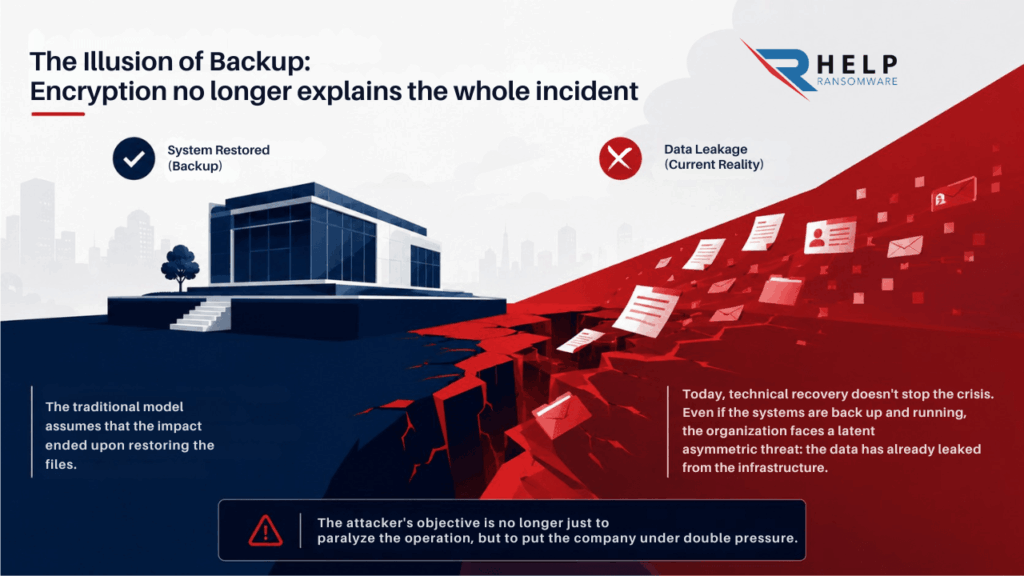
Encryption no longer explains the whole incident
In traditional models, recovery depended largely on whether the company could restore its files. If backups or recovery solutions existed, the organization had more leeway to weather the storm.
Now the problem is different. Even if a company manages to regain access to its systems, attackers can still threaten to publish stolen data, contracts, financial information, internal emails, or personal information. Therefore, ransomware decryption tools can help in some cases, but they don’t resolve an attack on their own that also involves data exfiltration, public exposure, and potential reputational damage.
Double pressure changes the response
The double extortion forces us to make more complex decisions. It’s no longer enough to know if the files can be restored. We also need to know what data has been leaked, what the legal repercussions might be, what information needs to be shared, and how to protect the trust of clients, partners, and suppliers.
Many companies hit by ransomware discover that the crisis doesn’t end when their systems are back up and running. If there’s stolen data, potential leaks, or public exposure, the pressure continues.
Data theft as a weapon of pressure
In modern ransomware, data is not just a technical target. It’s a tool for blackmail. A customer database, internal documents, credentials, contracts, or financial information can be used to pressure the company even after it has recovered its systems.
Data leakage can be more damaging than encryption.
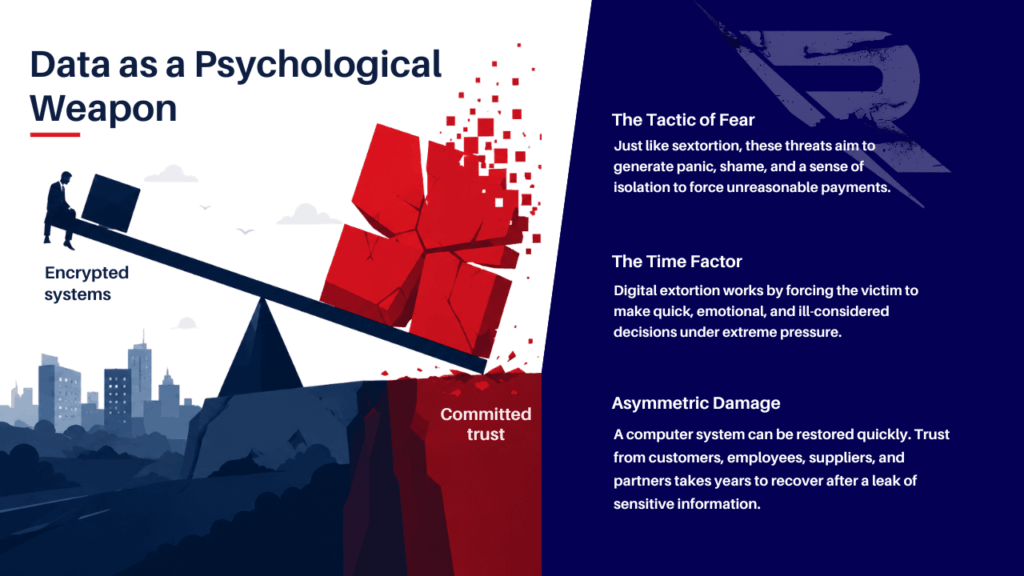
A system can be restored. Trust, however, takes much longer to recover. When attackers threaten to release sensitive information, the company faces a technical, legal, and reputational problem all at once.
The damage depends not only on how many files are encrypted, but also on what information has been compromised and how it might affect customers, suppliers, employees, or partners. At this point, ransomware becomes a crisis of trust.
Digital extortion seeks to instill fear
INCIBE has issued a warning about sextortion scams using emails, where attackers employ threats, urgency, and psychological pressure to extort payments. While not all of these cases involve enterprise ransomware, they share a common logic: extortion works when it generates panic, shame, urgency, or a sense of isolation.
Therefore, the relationship between sextortion and ransomware is relevant. Both phenomena use pressure on the victim to force quick, emotional, and ill-considered decisions.
Artificial intelligence and more credible threats
Artificial intelligence is also changing the landscape. This doesn’t mean all attacks are sophisticated, but it does mean that some campaigns can become more convincing, more personalized, and harder to detect.
The CCN-CERT has published a best practices report on offensive AI, which addresses how these capabilities can be used in malicious contexts. In modern ransomware, this can translate into more credible messages, better-written threats, or more personalized extortion attempts.
A generic threat can be more easily ignored. A threat that includes real names, internal documents, customer references, or organizational details creates much greater pressure. That’s where the attacker tries to control the pace of the crisis.
The technical answer is no longer enough
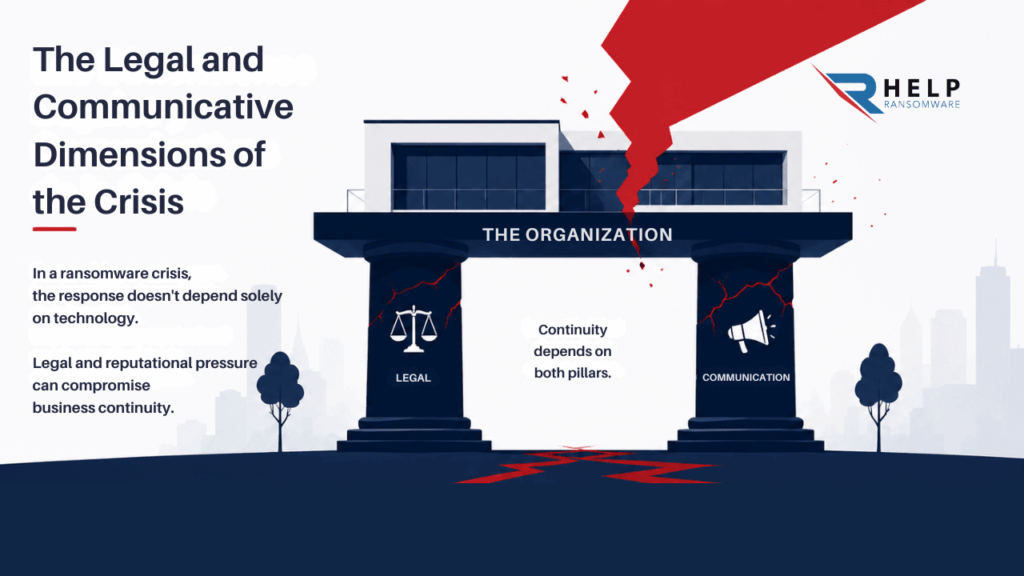
When ransomware is treated solely as an IT problem, organizations often delay making critical decisions. System recovery is essential, but it alone does not resolve data exposure, public disclosure, legal obligations, or reputational damage.
The incident turns into a business crisis
A modern attack can simultaneously affect IT, management, legal, communications, human resources, customer service, and operations. Each area needs information, but it’s not always immediately available.
That’s why crisis management becomes crucial. The company needs to coordinate decisions, control messaging, preserve evidence, and avoid contradictory responses. Without this coordination, a technical incident can escalate into a much larger crisis.
Communication is also part of defense
In an attack involving potential data theft, poor communication can exacerbate the damage. But remaining silent without a strategy can also create more uncertainty. The response must be fact -based, updated as reliable information becomes available, and avoid promises that the investigation cannot yet substantiate.
In modern ransomware, communication is not a minor detail. It’s a crucial part of impact mitigation.
The legal framework adds another layer of pressure
When data is stolen, legal and regulatory obligations may be triggered. The company must analyze whether personal data has been affected, whether it needs to notify authorities or affected individuals, and what measures it should take to mitigate the damage.
That’s why ransomware laws in 2025 are becoming increasingly important. A modern attack isn’t just managed by restoring systems. It also requires responding in a way that is compliant with the legal framework, preserving evidence, and protecting relationships with customers, partners, and regulators.
Public pressure can accelerate mistakes. Acting quickly is necessary, but acting without control can worsen the situation. In ransomware attacks, speed only helps if it’s accompanied by sound judgment, coordination, and a clear strategy.
What a company needs to understand about modern ransomware
Modern ransomware demands a broader perspective. It’s no longer enough to simply ask if files are encrypted. We need to know if there was unauthorized access, if data was extracted, what information might be compromised, and how external pressure will be managed.

Expert Ransomware Removal
Our certified professionals have over 25 years of experience in ransomware removal, data recovery, and computer security.
A prepared company doesn’t just have backups. It also knows who makes the decisions, how investigations are conducted, what evidence should be preserved, how to communicate, and what to do if attackers publish a sample of stolen information.
The goal is to reduce the attacker’s power. The better prepared the organization is, the less room the criminal will have to impose deadlines, manipulate communication, or turn uncertainty into a tool for extortion.
Modern ransomware no longer just encrypts. It also steals, threatens, and extorts.
At HelpRansomware, we work to help you respond with control, reduce operational and reputational impact, and make critical decisions when digital extortion puts your entire organization to the test.
Conclusion
Ransomware has evolved. Today it can combine encryption, data theft, reputational damage, direct threats, and legal obligations. Therefore, a response based solely on restoring systems is no longer sufficient.
Companies need to understand that the attack doesn’t end when they regain access to their files. If there was exfiltration, if the data could be published, or if the trust of customers and partners is compromised, the crisis continues.
The question is no longer just whether a company can decrypt its data.
The question is whether it can withstand all the pressure from modern ransomware.
Frequently Asked Questions about Modern Ransomware
What differentiates modern ransomware from traditional ransomware?
Traditional ransomware focused primarily on encrypting files. Modern ransomware can combine encryption, data theft, data breach threats, and reputational pressure.
What is double extortion?
It is a technique in which attackers encrypt systems and also threaten to publish or sell the stolen data if the victim does not pay.
Do decryption tools solve a modern attack?
They can help in some cases, but they don’t solve the problem if there was also data theft, exposure of sensitive information, or a threat of leaks.
Why is reputation so important?
Because attackers use the threat of public disclosure to increase pressure. Reputational damage can continue even after systems are recovered.
What should a company do in the face of a data breach threat?
You must preserve evidence, analyze the scope of the incident, coordinate the technical, legal and communication response, and avoid impulsive decisions under pressure.