The recent publication of the the principles for combating cyber risks in OT by CISA, the NCSC, and the FBI are not a technical warning or a one-off reaction to a specific incident. It is a fundamental statement: the institutions have acknowledged that OT ( operational technology) environments have become one of the most critical scenarios for ransomware attacks.
This stance is not accidental. For years, ransomware attacks have been analyzed primarily from an IT perspective, focused on systems, data, and recovery. However, when the attack reaches OT, that logic is no longer sufficient. OT systems support physical and operational processes that cannot always be stopped, isolated, or restored without serious consequences.
For this reason, ransomware in OT is not measured solely in encrypted files or disrupted services, but also in lost time, forced decisions, and loss of operational control . This is the perspective from which the current institutional approach, and also the analysis we conduct at HelpRansomware, should be understood.
OT changes the rules of ransomware
In OT environments, ransomware doesn’t behave the same way as in IT. The priority shifts from recovering systems to maintaining operational continuity for as long as possible . In many cases, halting an industrial process, a production line, or an essential service is not a realistic option.
Operational continuity as a pressure factor
This reality explains why the principles promoted by organizations such as the The National Cyber Security Centre (NCSC) emphasizes the importance of advance planning, assigning responsibilities, and access control. By the time an attack is already underway in OT systems, most defensive measures are too late.
From HelpRansomware‘s experience, this point is key. Many organizations have advanced detection tools, backups, and well-defined response plans for IT, but they haven’t extended that same level of preparedness to OT . When ransomware affects these systems, the question shifts from “how do we contain it” to “what sacrifices are we willing to make?”
At that moment, even knowing what to do in the face of a ransomware attack becomes a complex exercise, because the decisions have an immediate impact on the operation.
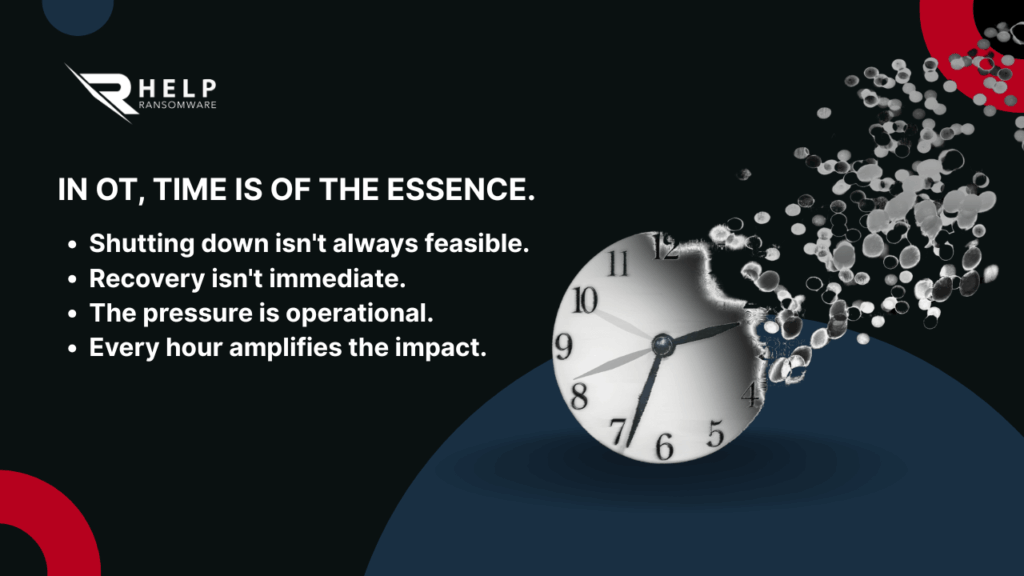
In OT incidents, every hour of downtime can translate into operational, contractual, and regulatory losses that are difficult to reverse.
In many cases, the real impact is measured in days, not in encrypted systems.
Where do organizations fail most when ransomware hits OT?
Ransomware attacks in OT rarely originate in OT. In most incidents, the entry point is located within the IT environment, through known vectors that continue to function because they exploit human error, trust, or a lack of continuous review.
Phishing remains one of the most effective methods for initiating an attack chain. From there, attackers apply the Tactics used by ransomware hackers to stay in the system, move laterally, and understand the architecture before acting.
When response plans do not include OT
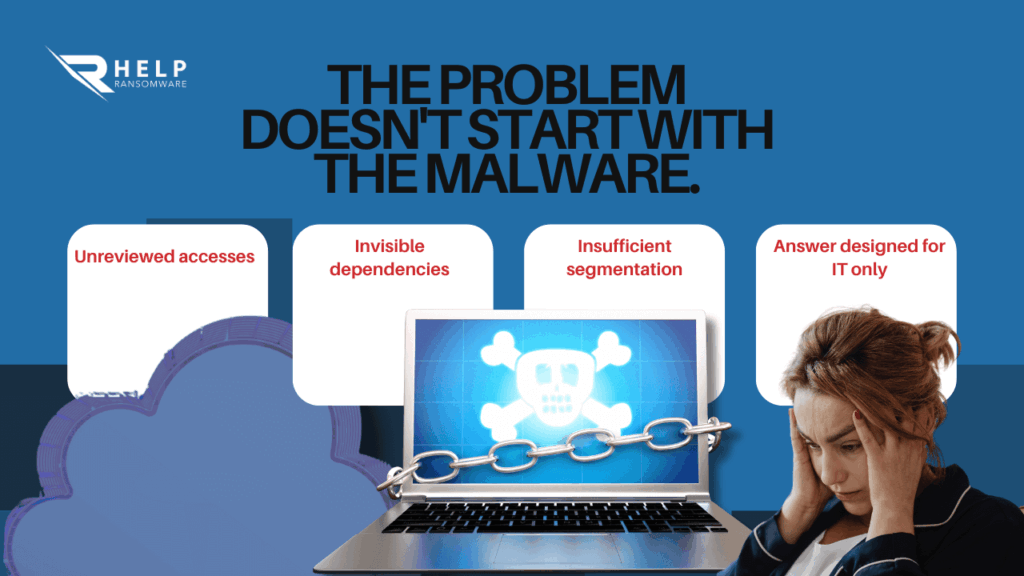
The problem is compounded when this lateral movement reaches OT systems that were not designed to be exposed to these types of threats. Legacy access, incomplete segmentation, or poorly documented dependencies make the incident difficult to contain.
At this point, many organizations discover that their response plans were designed only for IT. In OT, those plans aren’t always applicable, and improvisation becomes the norm, precisely when there’s the least margin for error.
Ransomware in OT as an extortion model
From an operational and research perspective, ransomware in OT should be understood as a pressure-based extortion model , not simply a technical attack. As research fromThe FBI on cybercrime and ransomware : the goal is not always to encrypt systems, but to demonstrate the ability to affect operations.
In OT, this pressure is especially effective. The inability to halt critical processes turns every minute into a bargaining chip. The threat lies not only in what is already affected, but also in what could stop working if quick decisions aren’t made.
When there are no clear criteria, defined responsibilities, or previously assessed scenarios, making a late decision becomes part of the problem. The cost is not limited to the rescue itself, but extends to operational disruption, loss of trust, and reputational damage.
Conclusion
The principles published by CISA, NCSC, and FBI don’t describe a future risk, but a present reality. Ransomware is already impacting OT, and when it does, improvisation ceases to be a viable option .
From HelpRansomware, the reading is clear: the difference between a controlled incident and a prolonged crisis is not in the tool deployed at the last minute, but in the decisions that were made before the attack , when there was still room to choose.