
Recent analyses surrounding the recommendation system of X have reignited a broader discussion: how algorithmic systems influence content visibility and, ultimately, collective behavior.
Beyond political or media framing, the relevant issue is structural. Digital platforms operate through optimization models designed to maximize interaction. They do not optimize for truth; they optimize for engagement. And when engagement becomes the dominant visibility metric, specific behavioral dynamics are reinforced at scale.
This is not an ideological debate. It is an architectural one.
Algorithmic Amplification and Regulatory Recognition
European regulation already acknowledges that recommendation systems may generate systemic risks. The European Commission Digital Services Act imposes obligations on Very Large Online Platforms to assess and mitigate risks arising from their algorithmic systems, including the impact of large-scale content amplification.
The regulation does not focus on political alignment. It focuses on structural consequences. When millions of users operate within an environment optimized for immediate response, the outcome is not merely informational. It is behavioral.
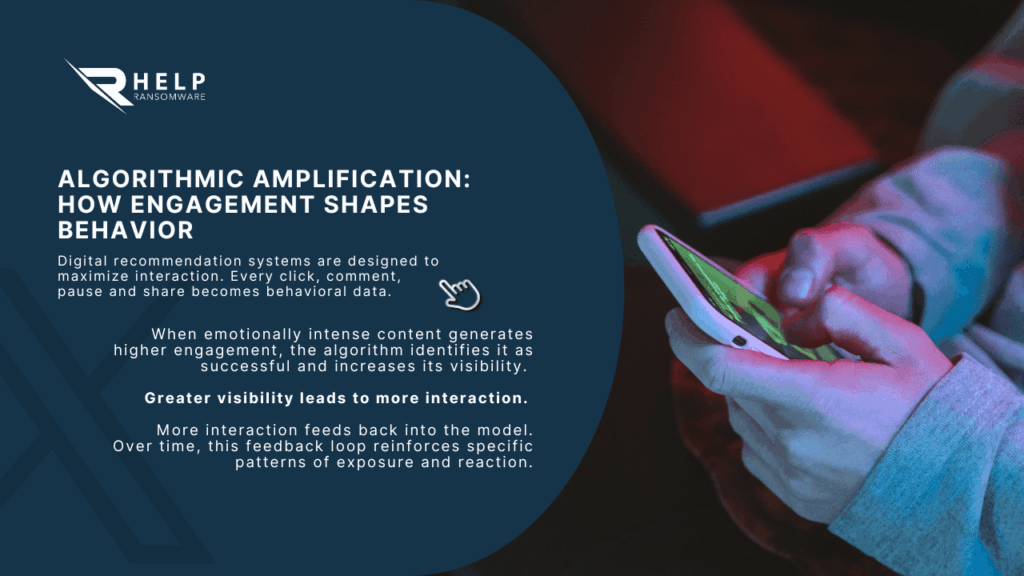
Recommendation models rely on machine learning trained on interaction patterns. If emotionally intense content generates stronger engagement, the system classifies it as effective and increases its visibility. That visibility generates more engagement, reinforcing the same pattern.
A feedback loop emerges where reaction fuels amplification and amplification fuels reaction.
Reduced Critical Friction and Exposure to Manipulation
The ENISA Threat Landscape highlights how digitally amplified environments can increase exposure to manipulation and engineered deception.
When digital infrastructure rewards immediacy, critical friction — the pause required for contextual verification — gradually declines. Urgency becomes normalized. Verification becomes secondary.
This dynamic does not directly create cyber incidents. However, it produces a context in which manipulation encounters less resistance.
From Amplified Ecosystems to Organized Crime Exploitation
The Europol Internet Organised Crime Threat Assessment confirms that organized crime groups increasingly exploit established digital behaviors, particularly those based on psychological pressure and induced urgency.
Modern attack chains often begin not with sophisticated code execution, but with a conditioned decision.
This is where the connection to Ransomware becomes critical. Many contemporary incidents start with a seemingly legitimate action: approving a request, validating a communication, or opening an attachment that aligns with an emotionally primed context.
As analyzed in Ransomware 2025 human factor, behavioral predictability has become one of the primary attack vectors. The vulnerability is not ignorance — it is conditioned response.

Artificial Intelligence and Behavioral Amplification
The convergence between algorithmic systems and automation further complicates the landscape. In AI in cybersecurity, we explore how artificial intelligence strengthens both defense mechanisms and offensive capabilities.
When AI enhances social engineering techniques, credibility increases. Algorithmic environments do not execute ransomware themselves, but they may contribute to an ecosystem that lowers critical resistance before an attack unfolds.
The risk does not reside solely in encryption code. It resides in the environment that makes encryption effective.
When Encryption Appears, the Context Was Already Built
In many incidents, by the time encryption is triggered, the decision-making environment has already been shaped.
Understanding What To Do If A Ransomware Attack Has Encrypted Your Data is essential for response. However, preventing escalation into a Ransomware Crisis requires examining the conditions that enabled the initial decision.
Algorithmic amplification is not the attack itself. But it may be part of the broader risk ecosystem.
Conclusion
The case of X should not be viewed solely through a political lens. It illustrates how modern digital infrastructure can shape behavior at scale.
European regulatory frameworks recognize systemic algorithmic risks. Cybersecurity reports warn about digital manipulation. Law enforcement assessments confirm that criminal groups exploit conditioned behavioral patterns.
From incident analysis experience, one conclusion is clear: ransomware rarely begins with encryption.
It begins with a decision taken within a previously conditioned environment.
Understanding that environment is now a strategic security necessity.