An artificial intelligence assistant that answers questions using contracts, manuals, tickets, or internal policies can save hours of searching. But it can also become a channel for injecting malicious instructions, altering recommendations, or revealing information a user should not be able to see.
The risk appears when a company assumes that every document consulted by its AI is trustworthy. RAG system security requires protecting sources, permissions, and responses: a seemingly legitimate file can influence the output without changing the artificial intelligence model itself.

Expert Ransomware Removal
Our certified professionals have over 25 years of experience in ransomware removal, data recovery, and computer security.
What Is a RAG System and Why Does It Need Security?
RAG stands for Retrieval-Augmented Generation. Instead of responding only with what it learned during training, the model searches for relevant passages in a knowledge base and adds them to the context used to generate its response.
That knowledge base may contain PDF files, wikis, emails, technical documentation, or corporate repositories. Protecting these sources is part of cybersecurity in the age of AI.
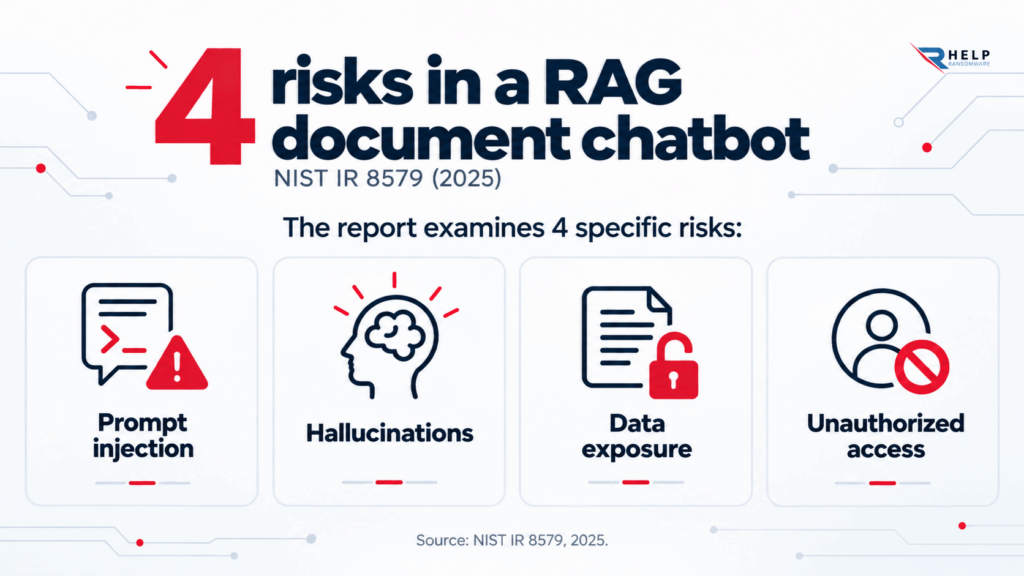
In 2025, NIST documented the development of an internal RAG-based chatbot for querying cybersecurity publications and identified threats such as instruction injection, fabricated responses, information exposure, and unauthorized access.
Its report on the NCCoE chatbot illustrates why the design of a document search system must also be evaluated as a security system.
Responses Depend on Documents and Permissions
A typical workflow has several stages: file ingestion, chunking, creation of vector representations, retrieval of matches, and generation of a response.
If validation, file classification, or user-level filtering fails, the AI may retrieve manipulated content or information outside the user’s authorization.
RAG system security does not mean retraining the model: attackers typically try to modify the information it retrieves for each request, not its internal parameters. That is why controls must extend to the document knowledge base.
How an Attacker Can Manipulate a RAG AI System’s Responses
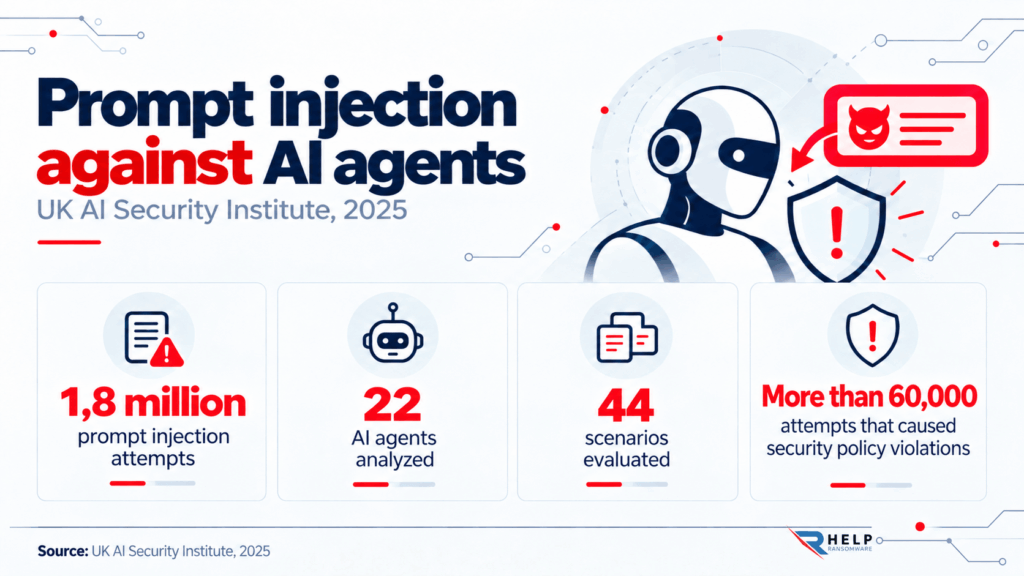
The entry point may be a shared document, an indexed webpage, a support ticket, or an attachment added to the knowledge base. The content appears to be reference material, but it includes instructions designed to override the assistant’s rules.
If the system retrieves that content without sufficient controls, the model may follow malicious instructions, distort its response, or treat manipulated information as legitimate.
Indirect Prompt Injection in Retrieved Files
An instruction hidden in a PDF could tell the assistant to ignore a purchasing approval rule or disclose confidential data. The model receives that text as part of the retrieved documentation and may mistake it for a legitimate instruction. This pattern is known as indirect prompt injection, a form of prompt injection.
The UK NCSC explains this weakness: language models do not guarantee a strict technical separation between the data they receive and the instructions they are expected to follow. Filtering suspicious phrases alone does not eliminate the risk.
Poisoned Documents and Biased Results
Another route is data poisoning applied to retrieval sources. An attacker may insert false policies, alter dates, or impersonate the current version of a procedure.
They may also upload documentation engineered to rank as especially relevant in searches. As a result, incorrect answers can appear to be supported by authoritative documentation.
The distinction matters: a manipulated document does not necessarily mean the model has been retrained. The contamination occurs in the knowledge base being queried. It is a practical form of the risk examined in data poisoning.
Security Risks to Company Data
Manipulated responses can have operational consequences: an HR AI system could misinterpret a procedure; a legal tool could cite a nonexistent clause; or a support assistant could recommend unsafe changes.
The risk increases when those responses trigger automated actions or are used without human verification. They may also lead to data exposure, unauthorized access, or incorrect decisions, extending the impact beyond the AI system itself.
In a multi-department environment, search must not return passages simply because they match the question. It must verify who is requesting the information, which documents that person is allowed to access, and whether those permissions are still valid.
A shared vector store without adequate controls can mix financial, employment, or contractual information across users.
OWASP identifies these weaknesses as LLM08:2025 Vector and Embedding Weaknesses and recommends logical segmentation, granular permissions, source validation, and retrieval logging. Its official guidance on vector and embedding risks is particularly relevant to enterprise RAG applications.
It is also not enough to hide a response in the interface: permissions must be enforced before passages are retrieved. If the system receives restricted content in its context, a potential exposure has already occurred and warrants investigation.
How to Strengthen RAG System Security
Prevention starts before a document reaches the index. The company needs an inventory of sources, designated publishing owners, sensitivity classifications, and clear criteria for accepting, modifying, or removing files.
Testing should cover both response accuracy and the possibility of abuse. It is also important to apply access controls, document validation, and continuous monitoring to detect suspicious changes or manipulated content within the knowledge base.
Validate Sources and Control Every Update
Maintain verifiable versions, validate new files, detect hidden text, and preserve an audit trail showing who introduced each change. When a policy is updated, indexed passages should be reviewed so that an outdated version does not continue to appear as current.
A response may display references, but citations do not replace authenticity checks. Sources should still be verified before they are treated as reliable input for the system.
Apply Least Privilege and Limit Tool Access
The search engine must respect the original identity and permissions of the repositories. Sensitive scopes should preferably use separate indexes, or verified access filters should be applied before context is delivered to the model.
If the assistant can send emails, run queries, or modify records, those actions must pass through technical authorization controls that are independent of the generated text.
Measure Attacks, Log Events, and Test Recovery
Security testing should include documents containing adversarial instructions, attempts to query across departments, falsified results, and requests designed to extract information from the organization.
Logging retrieved documents, versions, user identity, responses, and actions performed makes it easier to identify the path of an incident.
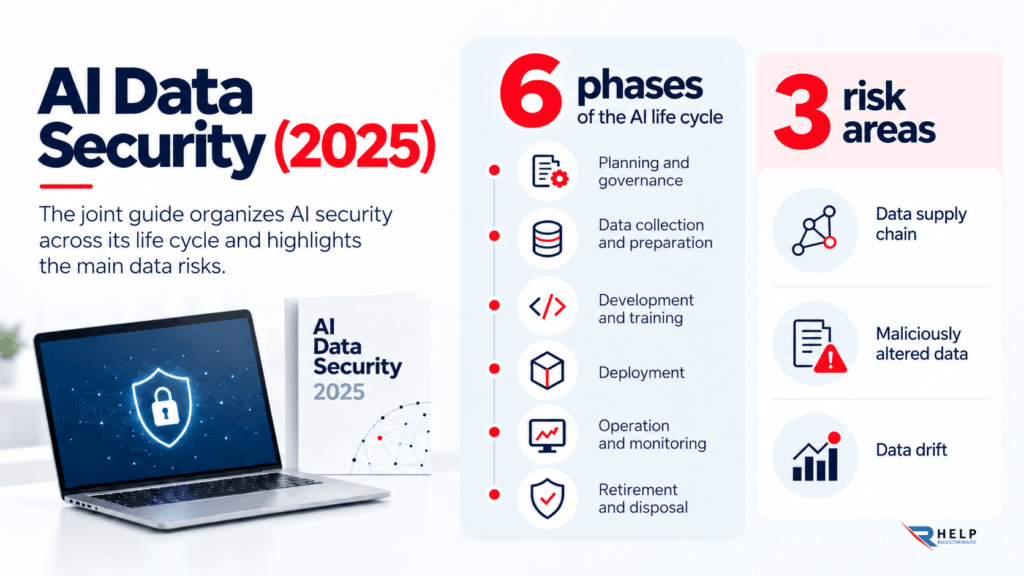
The joint AI data security guidance published in 2025 by agencies in the United States, Australia, New Zealand, and the United Kingdom emphasizes protecting data throughout the entire lifecycle through validation, access control, traceability, and continuous monitoring. The document is available through AI Data Security, the Australian Government’s official portal.
What to Do If Your RAG Assistant Is Already Producing Manipulated Responses
If unusual answers, impossible citations, or information from other departments appears, temporarily suspend access to the suspected sources and preserve evidence.
The team must identify the affected query, the retrieved passages, their source, and the identities of users who may have received unauthorized information.
Next, remove or quarantine the compromised content, rebuild the necessary indexes, review permissions, and compare results against authentic documentation.
If there was unauthorized access or a data leak, the case should be treated as a security incident by activating the cyberattack response plan and any applicable legal processes.
Changing a chatbot instruction and continuing is not enough. Recovery requires confirming that the altered source no longer appears, that indexes have been updated, and that adversarial tests cannot reproduce the failure.

Immediate Ransomware Help
Don’t let ransomware hold your business hostage. Our experts are ready to recover your data and secure your systems.
Conclusion
A RAG system can make corporate knowledge easier to access, but it also allows external content to directly influence what the AI says. Protecting the model without protecting documents, permissions, vectors, and logs leaves a significant attack surface exposed.
RAG system security is built on trusted sources, real access controls, manipulation testing, and a defined incident response process. For organizations integrating AI into critical operations, assessing these controls before deployment is just as important as measuring the assistant’s usefulness.
FAQ
Yes. It only needs to retrieve manipulated or unauthorized documents for a response to be affected. The risk lies in retrieval and use of the content, not necessarily in training. That is why the sources and the mechanisms that feed information into the system must also be protected.
No. Citations help users review what was retrieved, but the source itself may also be manipulated. Its provenance must be validated, and the model must be prevented from treating hidden instructions as commands. It is also advisable to limit which content can influence system behavior during retrieval.
By applying access controls at the search layer, linked to the user’s identity and actual permissions for each document. The interface alone should not decide which passages are retrieved. The retrieval system must enforce permissions before any content is sent to the model.
Not always. Derived passages and vectors must also be removed, indexes and caches updated, affected queries reviewed, and the system verified to ensure the content no longer appears in responses.
Responsibility is shared: IT manages infrastructure and permissions; security tests for abuse and monitors activity; data-owning teams validate content; and leadership defines risk tolerance and oversight.