
Over the past few years, artificial intelligence has established itself as one of the most powerful drivers of technological transformation. Its ability to analyze vast amounts of data, identify complex patterns, and automate decisions has revolutionized key sectors such as medicine, finance, and, most importantly, cybersecurity. However, this progress presents a troubling paradox: the very technology that today strengthens digital defenses is also being used by attackers to refine ransomware campaign sand other increasingly sophisticated cybercrimes.
Immediate Ransomware Help
Don’t let ransomware hold your business hostage. Our experts are ready to recover your data and secure your systems.
Talking about cybersecurity in the age of AI means acknowledging an uncomfortable truth: artificial intelligence is neither inherently defensive nor offensive. It is a tool. And like any powerful tool, its impact depends on who uses it, for what purposes, and under what controls. When an organization suffers an AI-driven attack, the problem is no longer limited to a specific technical vulnerability. It represents a paradigm shift that reduces reaction times, increases the precision of the attack, and significantly raises operational, legal, and reputational risks.
Artificial intelligence as a new pillar of digital defense
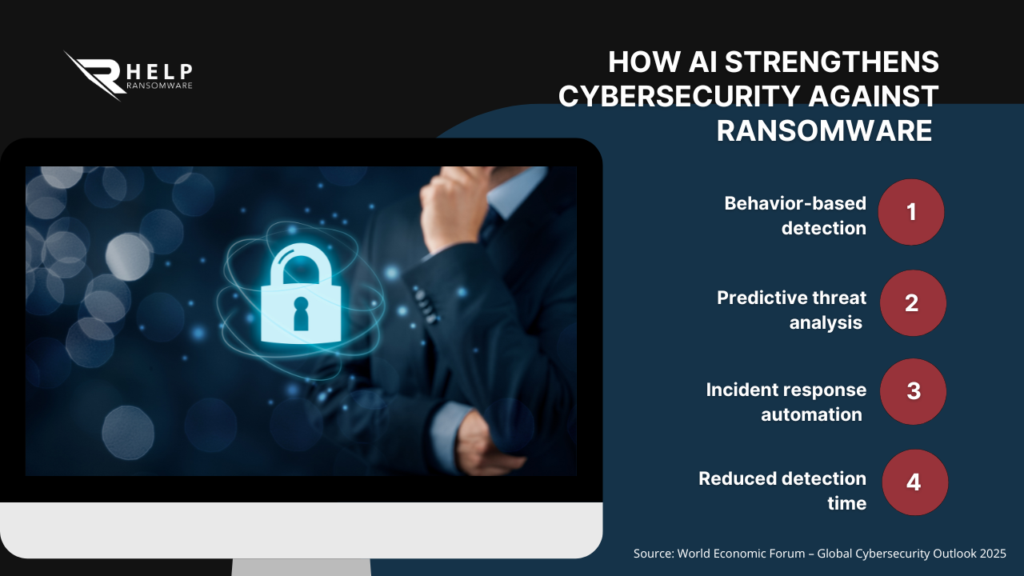
The integration of AI into cybersecurity solutions has represented a significant leap forward compared to traditional approaches. Unlike systems based solely on static rules or known signatures, AI allows for the analysis of behaviors, the correlation of events, and the anticipation of threats before they materialize.
Systems based on machine learning can detect traffic anomalies, unusual access patterns, or behavioral patterns that indicate a potential intrusion, even when there is no prior signature of the attack. This is especially effective against modern ransomware, which typically evades traditional defenses through obfuscation, encryption, and constant mutation techniques.
Furthermore, AI-powered automation dramatically reduces response times. Instead of relying solely on human intervention, systems can isolate devices, revoke credentials, or block suspicious processes in a matter of seconds. In an environment where every minute counts, this capability can mean the difference between a contained incident and a full-blown crisis.
This view coincides with the analysis of the World Economic Forum in its Global Cybersecurity Outlook 2025, which highlights that artificial intelligence is redefining both defensive capabilities and the threat profile, forcing organizations to rethink their digital protection strategies.
When AI becomes a weapon: the other side of ransomware
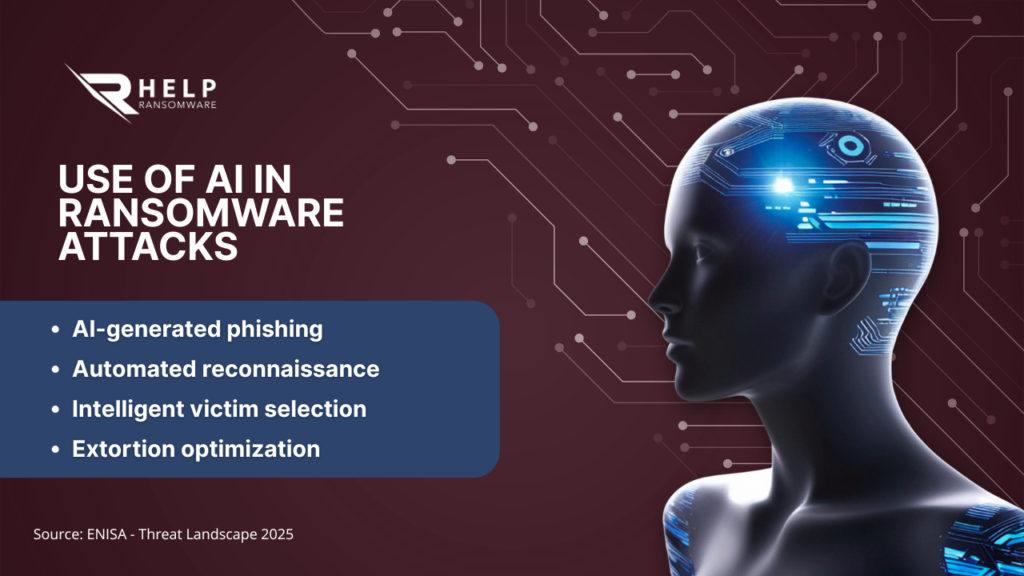
The main risk arises when artificial intelligence ceases to be a defensive tool and begins to enhance the offensive capabilities of attackers. Ransomware groups have adopted AI to automate tasks, escalate attacks, and maximize the impact of extortion.
Today, AI is used to generate highly personalized phishing emails, capable of mimicking the language, tone, and context of legitimate communications. It also allows for the analysis of large volumes of stolen data to identify the most profitable victims, tailor the extortion message, and choose the most effective moment to apply pressure.
Unlike traditional attacks, AI-assisted attacks learn and evolve. If a technique stops working, the model adjusts. This ability to continuously adapt makes early detection extremely difficult and significantly increases the ransomware’s success rate.
The arms race in modern cybersecurity
The adoption of artificial intelligence has triggered a veritable digital arms race. While companies implement increasingly advanced defensive solutions, attackers adjust their tactics to circumvent them. The technological advantage is always temporary.
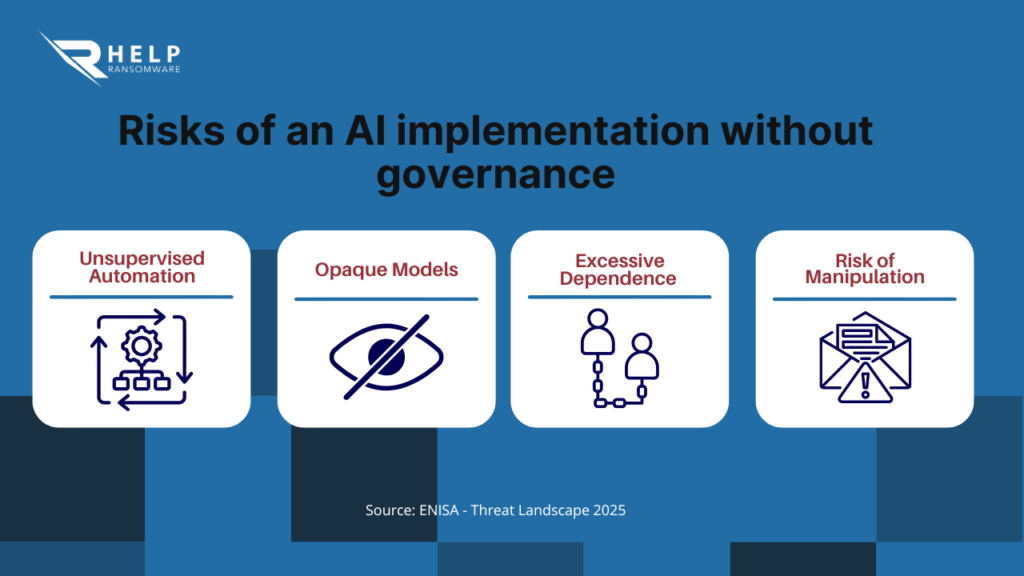
In this context, relying solely on technology is a strategic mistake. AI does not replace governance, training, or planning. In fact, poor implementation can create a false sense of security, as has already been observed in complex incidents such as the AWS global incident, where over-reliance on automation amplified the impact of the failure.
The ENISA Threat Landscape 2025 underlines that the sophistication of threats, combined with the increasing use of AI by malicious actors, is accelerating the emergence of faster, more precise attacks with greater systemic impact.
AI, ransomware, and the operational and reputational impact
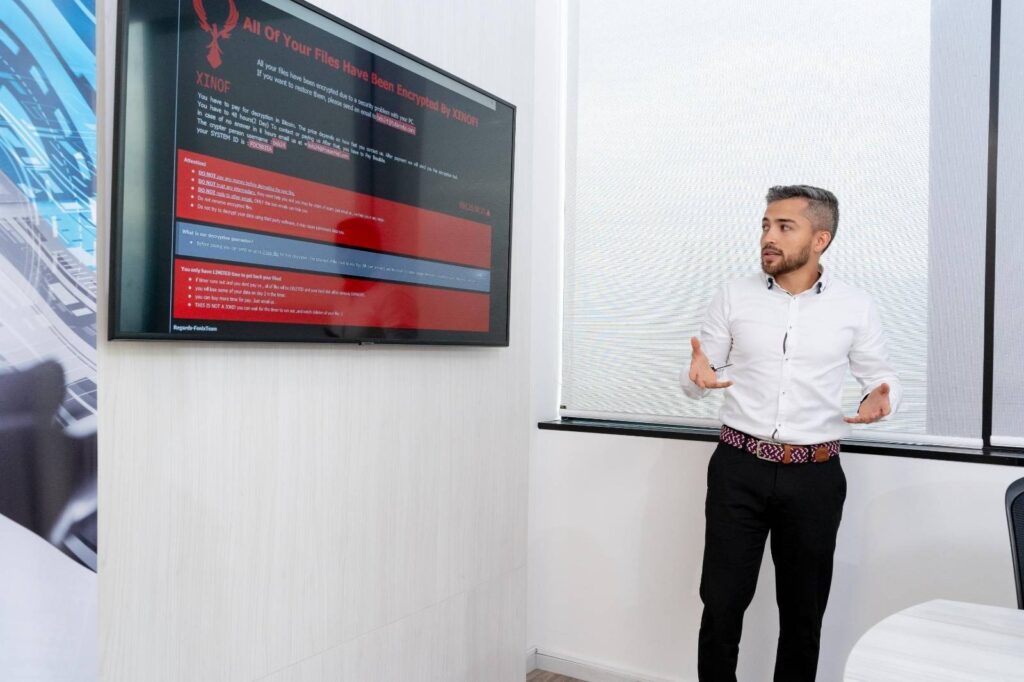
Artificial intelligence-driven ransomware doesn’t just increase technical damage. Its impact extends to reputation, trust, and business continuity. The speed of propagation and the personalization of attacks reduce the window for response and increase the likelihood of data breaches and public exposure.
In this scenario, protecting against ransomware is no longer just a technical matter. It involves organizational preparedness, interdepartmental coordination, and a clear communication and response strategy. Companies that underestimate this aspect often discover too late that reputational damage persists long after operational recovery.

Immediate Ransomware Help
Don’t let ransomware hold your business hostage. Our experts are ready to recover your data and secure your systems.
The need for a balanced strategy: technology, people, and processes
The true strength of cybersecurity in the AI era lies not in adopting the latest technology, but in integrating it into a balanced and well-governed strategy. Artificial intelligence should complement, not replace, human expertise and structured risk management processes. Organizations that rely exclusively on automation without clear oversight often underestimate how quickly AI-driven systems can introduce new vulnerabilities if they are not properly supervised.
This requires continuous training of teams, clear boundaries for automation, regular auditing of AI models, and incident response plans that account for advanced, AI-enabled threat scenarios. Without this holistic approach, artificial intelligence can unintentionally become a single point of failure, amplifying risk instead of mitigating it.
This perspective is reinforced by academic research from MIT Sloan and MIT CSAIL, which emphasizes that effective AI-driven cybersecurity depends as much on governance and decision-making frameworks as on technology itself. Their analysis highlights that organizations must align AI adoption with leadership accountability, transparency, and human oversight to prevent automation from undermining resilience.
In the words of our CEO, Juan Ricardo, in a strategic reflection aligned with modern risk management:
“Artificial intelligence does not eliminate risk, it redistributes it. Organizations that delegate their security without fully understanding the technology are creating a strategic vulnerability, not a competitive advantage.”
Conclusion
Artificial intelligence is redefining cybersecurity. It can be a powerful ally against ransomware, but also an extremely effective tool in the hands of attackers. The difference lies not in the technology, but in the strategy.
Understanding cybersecurity in the age of AI means accepting that risk evolves, that automation has limits, and that responsibility still lies with the organization. Companies that integrate AI with robust governance, training, and response plans are better prepared to face ransomware attacks of today and tomorrow.
Frequently Asked Questions (FAQ)
Cybersecurity in the age of AI implies a profound shift in how systems, data, and organizations are protected. It’s no longer just about reacting to known threats, but about anticipating them through predictive analytics, anomalous behavior detection, and intelligent automation. At the same time, it demands an understanding that artificial intelligence is also used by attackers, requiring a strategic approach that integrates technology, people, and processes.
No. Artificial intelligence significantly reduces risk, but it cannot eliminate it entirely. Attackers also use AI to adapt their techniques, evade controls, and automate attacks. Therefore, AI should be understood as an advanced defense enhancement, not a complete solution. Effective prevention requires governance, staff training, and well-defined response plans.
Because it allows for faster and more precise automation and scaling of attacks. AI facilitates the creation of customized phishing campaigns, the analysis of stolen data to select victims, and the continuous adaptation of extortion techniques. This reduces organizations’ reaction time and increases the likelihood of a successful attack.
Yes, and in many cases they are priority targets. SMEs tend to have fewer resources, less cybersecurity maturity, and greater digital dependence, making them attractive targets. AI allows attackers to automatically identify vulnerable organizations, increasing the risk even for companies that are not considered “relevant.”
Not necessarily. Artificial intelligence only adds value when implemented with governance, human oversight, and clear processes. Without these elements, it can create a false sense of security or become a new point of failure. The key is not to use AI, but to use it responsibly and strategically.
Yes. AI systems can generate false positives and false negatives, especially if the models are not well-trained, updated, or supervised. Furthermore, there are manipulation techniques known as adversarial machine learning that can deceive the models. Therefore, human validation remains essential for critical decisions.
It remains a critical factor. Although AI strengthens technical defenses, many attacks begin with social engineering, where people are the primary entry point. Artificial intelligence has made these deceptions more sophisticated, but ongoing training, awareness, and a strong security culture remain key barriers against ransomware.
Indirectly, yes. By accelerating the spread of attacks and increasing their accuracy, AI increases the likelihood of data breaches, prolonged disruptions, and public exposure. This can lead to a loss of trust, media pressure, and reputational damage that persists long after technical recovery.
Organizations must adopt a comprehensive strategy that combines advanced technology, trained personnel, and well-defined processes. This includes the responsible use of defensive AI, incident response plans, regular drills, coordination between technical, legal, and communications departments, and continuous monitoring of automated systems.
It will depend on how it is used. In responsible hands, with adequate controls and a clear strategy, AI will be a key ally against ransomware and other advanced threats. Without governance, oversight, and training, it can become a critical threat that amplifies existing risks. The difference lies not in the technology itself, but in the maturity with which it is managed.

Expert Ransomware Removal
Our certified professionals have over 25 years of experience in ransomware removal, data recovery, and computer security.