
For years, ransomware attacks were treated as purely technological incidents, confined to the IT department and managed as operational problems that could be resolved by restoring systems or recovering backups. Today, that view is clearly insufficient. Modern ransomware has evolved into a threat that directly impacts reputation, trust, and business continuity, affecting the company’s public image even more than its internal operations.
Data breach occurs, the problem is no longer limited to system disruption. The real challenge begins when customers, partners, investors, and regulators start questioning the company’s ability to protect the data it manages. At that point, the incident ceases to be technical and transforms into a high-impact reputational crisis, with consequences that can last for months or even years.

Fast & Guaranteed Recovery
HelpRansomware provides a 100% guaranteed ransomware removal and data recovery service, with 24/7 worldwide assistance.
Discussing how to avoid a reputational crisis caused by a data breach requires accepting a key reality: reputation isn’t something you can improvise during a crisis. It’s built or destroyed long before the attack occurs, through strategic decisions, organizational culture, preparedness, and leadership.
Why ransomware has become a reputational threat
Modern ransomware is no longer solely aimed at disrupting operations or causing immediate financial damage. In its most recent evolution, it has become a tool for reputational pressure, designed to force swift decisions under intense public scrutiny. Attackers understand that damage to brand image can be more devastating than the operational disruption itself.
Unlike traditional cyberattacks, modern ransomware exploits public exposure. The threat is no longer just losing access to systems, but losing control of the narrative. When information about the attack leaks outside the organization, the company is subjected to immediate scrutiny from its stakeholders: customers who are skeptical, partners who demand explanations, regulators who are watching closely, and media outlets that amplify the impact.
This context makes every decision a reputational factor. Prolonged silence, contradictory messages, or overly technical communication are often perceived as signs of a lack of control or responsibility, exacerbating the crisis beyond the initial attack.
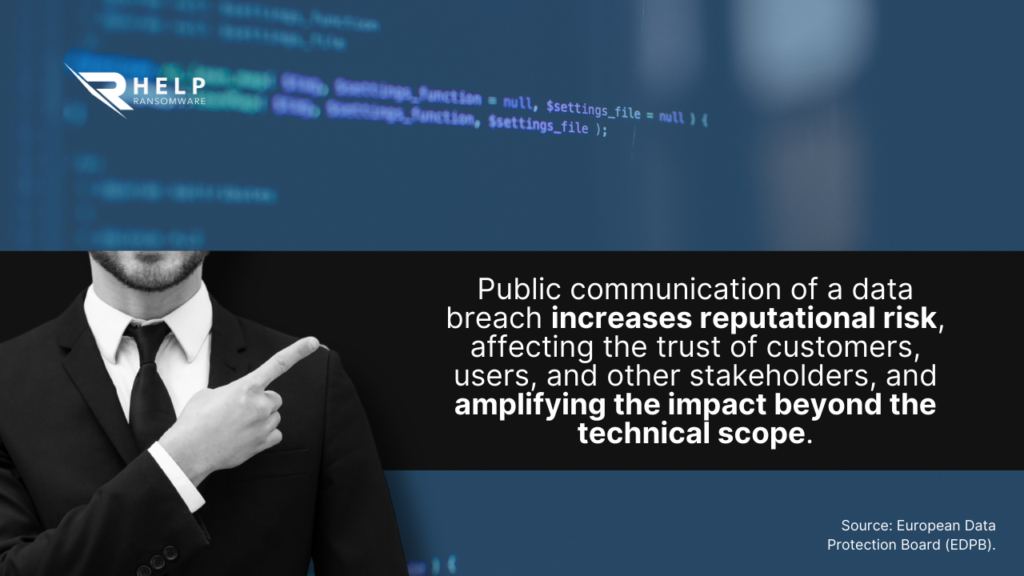
Several European institutional reports confirm that the public exposure of a data breach acts as a multiplier of reputational damage. The European Data Protection Board (EDPB), the highest European authority on data protection, points out in its annual report that the notification and disclosure of security incidents has a direct impact on the trust of customers, citizens, and stakeholders, especially when personal data is compromised and the information becomes public.
From security incident to crisis of confidence
When data is compromised, trust erodes immediately. Customers and partners don’t analyze the technical details of the attack; they assess the outcome: compromised information, uncertainty, and a sense of vulnerability. A delayed or confusing response amplifies this effect and can lead to contract cancellations, lost business opportunities, and a progressive decline in corporate reputation.
Data leaks as a trigger for reputational damage
Data breaches represent the point of no return in many ransomware attacks. While encrypted systems can be restored over time, exposed information can no longer be brought back under the company’s exclusive control. This fact marks a turning point in how the incident is perceived externally.
When data leaves the corporate perimeter, the focus shifts from the attack itself to the consequences. Customers, employees, and partners begin assessing the potential impact on their own information, generating uncertainty, mistrust, and constant pressure on the organization. Each new affected stakeholder amplifies the reputational damage and makes regaining credibility more difficult.
Furthermore, stolen data is rarely used only once. Its reuse in fraud, phishing campaigns, or new extortion attempts prolongs the crisis for months, keeping the perception of insecurity alive even after operational recovery.
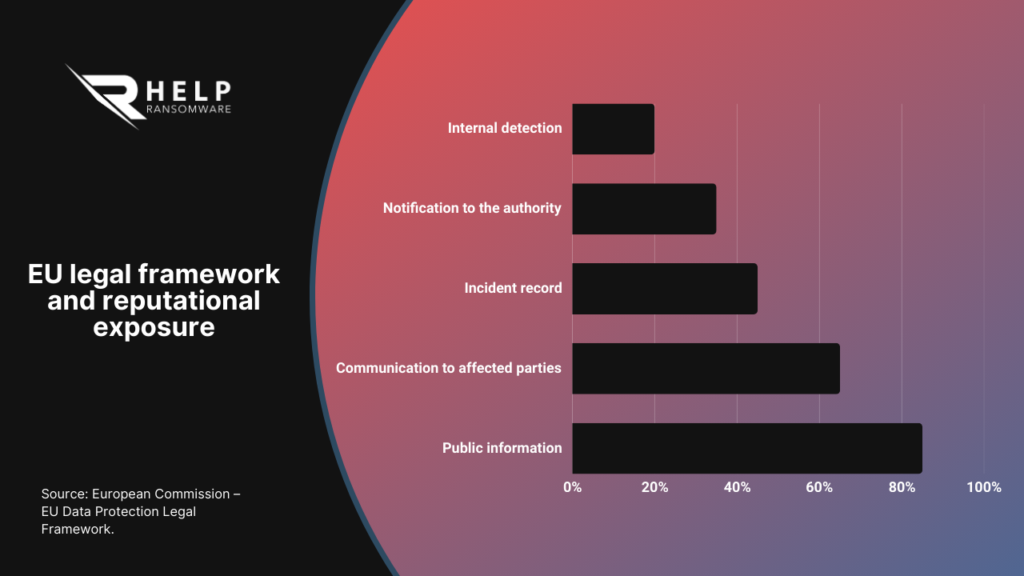
Data breaches not only have an immediate impact, but also trigger lengthy regulatory processes that can last for months or even years. The European Commission, in its official documentation on the application of the General Data Protection Regulation (GDPR), emphasizes that security breaches affecting personal data trigger ongoing legal obligations, oversight by supervisory authorities, and public scrutiny that directly impacts the trust of customers, citizens, and business partners.
When the systems come back, but the reputation doesn’t
Ransomware incident management is assuming the crisis ends when systems are restored. In reality, that moment often marks the beginning of the most complex phase of the problem. Even after operations return to normal, the company must face legal notifications, audits, regulatory investigations, and constant scrutiny from customers and the media.
Avoiding a reputational crisis doesn’t mean preventing all attacks, which is unrealistic in today’s environment. It means preparing to manage them effectively when they occur, understanding that reputation is part of the company’s security perimeter.
This involves engaging senior management and the board of directors, defining clear responsibilities, and having a cyberattack response plan that includes not only technical recovery, but also external communication, legal coordination, and decision-making under pressure.

Expert Ransomware Removal
Our certified professionals have over 25 years of experience in ransomware removal, data recovery, and computer security.
Reputational damage as a persistent consequence
Reputational damage is often the most lasting effect of a ransomware attack. Unlike technical costs, which can be quantified and addressed, the loss of trust is cumulative and difficult to reverse. Reputation does not automatically recover over time; it requires consistency, transparency, and visible changes that demonstrate learning and genuine commitment from the organization.
Reputation as a strategic asset after a cyber incident
The persistence of reputational damage is closely linked to collective memory, the consistency between words and actions, and the way organizations manage public perception over time.
Every new mention of the incident, every additional leak of information, or every media reference to the attack reactivates the perception of vulnerability, prolonging the effects of the event far beyond the initial moment. In a digital environment where information remains permanently accessible, the history of a ransomware attack can continue to influence brand perception for years.
Organizations that address this reality with a clear communication strategy and a commitment to continuous improvement typically reduce the impact significantly in the medium and long term. Acknowledging the incident and explaining the decisions made, while demonstrating the strengthening of prevention and response capabilities, allow for the gradual rebuilding of trust. In this context, reputation ceases to be a passive consequence of the attack and becomes an active element of the recovery strategy.
“In a ransomware crisis, the real difference is not made by technology alone, but by an organization’s ability to take responsibility, communicate transparently, and demonstrate that it has learned from the incident.”
— Andrea Baggio, CEO of HelpRansomware
Mistakes that worsen a ransomware reputational crisis
Not all reputational crises are explained by the sophistication of the attack. In many cases, it is the subsequent handling of the situation that amplifies the damage. Minimizing the incident, delaying communication, or issuing contradictory messages often creates a perception of a lack of control and accountability.
A particularly serious mistake in incident management is delegating the response and communication solely to technical teams, without effective coordination with senior management, legal teams, and corporate communications departments. This approach often results in overly technical, impersonal messages that are disconnected from the real concerns of customers and stakeholders, increasing confusion and exacerbating the impact of the incident.
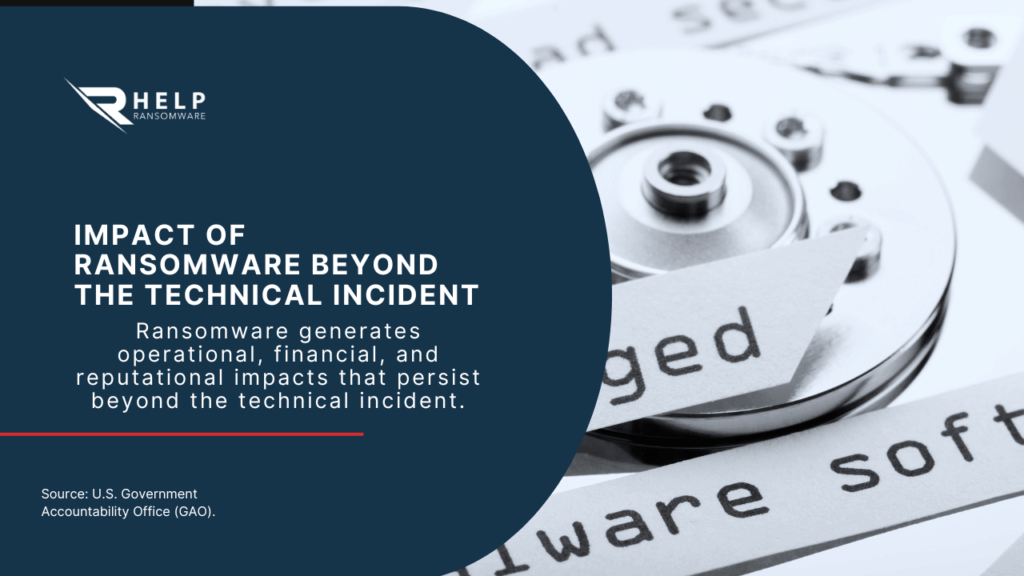
The United States Government Accountability Office (GAO), in its report on cybersecurity incident response, warns that the lack of interdepartmental coordination and clear leadership hinders effective incident management, prolongs their effects, and reduces organizations’ ability to contain the organizational and reputational impact of attacks.
How to avoid the worst-case scenario for your brand
Avoiding a reputational crisis doesn’t mean preventing all attacks, which is unrealistic in today’s environment. It means preparing to manage them effectively when they occur, understanding that reputation is part of the company’s security perimeter.
This involves engaging senior management and the board of directors, defining clear responsibilities, and conducting drills that include not only technical recovery, but also external communication and decision-making under pressure.
Organizations that integrate cybersecurity, crisis management, and communication significantly reduce reputational damage, even when an incident is unavoidable. Proper preparation allows for swift, consistent, and credible action during critical moments.
Conclusion:
A ransomware reputational crisis is not inevitable. To a large extent, it is the result of how an organization prepares, responds, and communicates. Reputation must be understood as a critical asset, on par with data and systems.
Knowing how to avoid the worst-case scenario for your brand involves anticipating problems, assuming that incidents happen, and acting with leadership, transparency, and consistency. In an environment where trust is fragile, protecting your reputation is protecting the future of your business.
Frequently Asked Questions (FAQs)
Because it involves a loss of control over sensitive data and publicly exposes shortcomings in security management and corporate responsibility. For customers, partners, and investors, a ransomware attack is not just a technical incident, but a warning sign that directly affects brand trust and credibility.
No. Restoring systems and resuming operations does not equate to restoring trust. Reputation is rebuilt through clear, empathetic, and transparent communication, as well as visible actions that demonstrate learning, accountability, and real improvements in data protection.
Not necessarily, but the risk increases significantly when the breach involves personal, financial, or strategic data. The greater the potential impact on customers, employees, or partners, the higher the likelihood that the incident will result in a reputational crisis.
Senior management should take a visible role, supported by the technical, legal, and communications teams. This leadership conveys control, commitment, and accountability, and avoids contradictory or overly technical messages that could worsen the public perception of the incident.
No. Paying the ransom does not guarantee that the data will not be leaked, nor does it eliminate the possibility of future extortion attempts. Furthermore, it can create a perception of weakness and increase public scrutiny, prolonging reputational damage rather than mitigating it.
It depends on the severity of the incident and how it’s handled, but it’s usually a lengthy process that can last for years. Reputational recovery requires consistency, sustained transparency, and demonstrable improvements in security management and data protection.
Yes. Reputation management should be integrated into the overall cybersecurity and crisis management strategy. Preparing to communicate, make decisions under pressure, and coordinate teams is just as important as technical protection measures.
Investors and the market interpret ransomware attacks as indicators of operational and governance risk. A poorly managed incident can affect brand value, business continuity, and the perception of the company’s solvency and reliability.
Yes. A swift, transparent, and responsible response can demonstrate organizational maturity and a commitment to security. In some cases, exemplary crisis management can strengthen trust in the medium and long term.
Prior preparation, visible leadership, and clear, honest, and consistent communication from the outset. Anticipating crisis scenarios allows for controlled action and minimizes reputational damage when an attack occurs.

Fast & Guaranteed Recovery
HelpRansomware provides a 100% guaranteed ransomware removal and data recovery service, with 24/7 worldwide assistance.