The AI Act is no longer a distant proposal. For many businesses, it has become a practical obligation that requires them to review how artificial intelligence systems are developed, purchased, integrated and used across the organization.
The challenge is not simply to “comply with a European law.” The real task is understanding which AI tools the company uses, what data they process, who controls them, what risks they create, and which security, transparency and oversight measures must be in place before an audit, complaint or incident occurs.
That is why talking about AI Act for businesses means talking about governance, cybersecurity, data protection and risk management. Organizations that wait until the last minute will find it harder to classify their systems, document decisions and demonstrate that they use AI safely and responsibly.

Fast & Guaranteed Recovery
HelpRansomware provides a 100% guaranteed ransomware removal and data recovery service, with 24/7 worldwide assistance.
What Is the AI Act and Why Does It Affect Businesses?
The AI Act is the regulatory framework of the European Union for artificial intelligence. Its purpose is to govern the use of AI through a risk-based approach: the greater a system’s potential impact on safety, fundamental rights or individuals, the greater the obligations.
For a business, this means not all uses of AI are treated the same. An internal chatbot used for productivity does not carry the same risk level as a system that determines access to employment, credit, education, essential services or critical processes. The key is to identify the use case, the company’s role and the applicable risk level.
This approach is directly linked to cybersecurity in the age of AI. If an organization uses generative models, automated assistants or artificial intelligence agents, it must manage not only system performance, but also the risks of data leakage, manipulation, bias, operational errors and third-party abuse.
Which Businesses Need to Prepare for AI Act Compliance?
The AI Act does not affect only model developers. It may also apply to companies that purchase, integrate or deploy AI systems in internal processes or services aimed at the European market.
An organization may act as a provider, deployer, distributor, importer or professional user, and each role carries different responsibilities.
That is why the first step is not to draft a generic policy, but to build a real AI inventory. The company needs to know which systems it uses, what they are for, what data they process, who manages them, which providers are involved and whether system outputs affect relevant decisions for customers, employees or third parties.
The informal use of external tools must also be reviewed. Many companies already have cases of shadow AI: employees using generative applications to summarize documents, write code, analyze contracts or prepare commercial responses without formal approval. Even when the goal is productivity, this can create confidentiality, compliance and security risks.
What the AI Act Requires Based on Risk Level
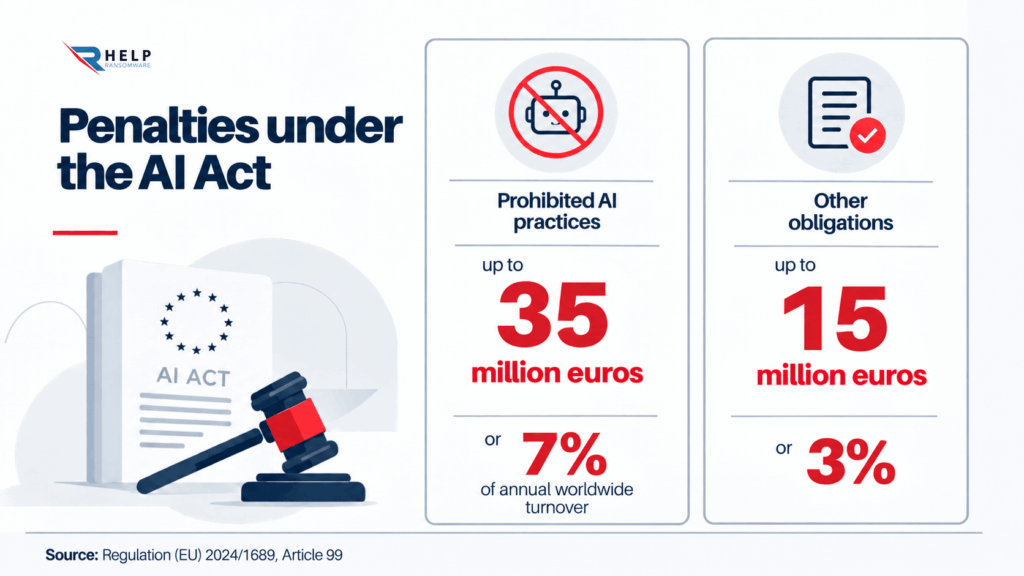
The AI Act classifies systems according to their risk level. Prohibited practices are excluded from the market. High-risk systems must meet stricter requirements.
Some limited-risk systems are subject to transparency obligations. General-purpose AI models are also subject to specific obligations for their providers.
Prohibited Practices
Prohibited practices are those the regulation considers incompatible with safety or fundamental rights.
For businesses, this requires reviewing use cases involving manipulation, exploitation of vulnerabilities, social scoring, certain biometric uses or systems that may affect people in abusive ways.
High-Risk Systems
High-risk systems require stronger controls: risk management, data governance, technical documentation, activity logging, human oversight, accuracy, robustness and cybersecurity.
If a business uses AI in recruitment, performance evaluation, essential services, education, critical infrastructure or regulated processes, it must assess whether the system falls into this category.
Transparency and General-Purpose AI Models
Transparency obligations are particularly relevant for chatbots, systems that generate synthetic content, deepfakes or tools that interact with users.
In addition, the obligations for general-purpose AI models include requirements for documentation, information for downstream providers, copyright compliance and, for models with systemic risk, risk assessment and mitigation.
AI Act, Cybersecurity and Business Data
Compliance with the AI Act cannot be separated from cybersecurity. An AI system may be vulnerable to prompt injection attacks, exposure of sensitive data, misuse of connectors, input manipulation or data poisoning. When the system has autonomy or access to internal information, the risk increases.
Compliance with the AI Act can also be supported by international risk management frameworks. The NIST AI Risk Management Framework provides a voluntary approach for incorporating trustworthiness, security and governance into the design, deployment and use of AI systems.
Article 15 of the AI Act requires high-risk systems to achieve appropriate levels of accuracy, robustness and cybersecurity throughout their lifecycle. This means security must be built in by design: access controls, traceability, testing, vulnerability management, human oversight and clear limits on what AI can do.
It is also essential to strengthen business data protection. A model that processes customer information, contracts, credentials, records or confidential data can become a leakage point if inputs, outputs, providers and permissions are not controlled.

Expert Ransomware Removal
Our certified professionals have over 25 years of experience in ransomware removal, data recovery, and computer security.
Key AI Act Dates Businesses Should Not Ignore
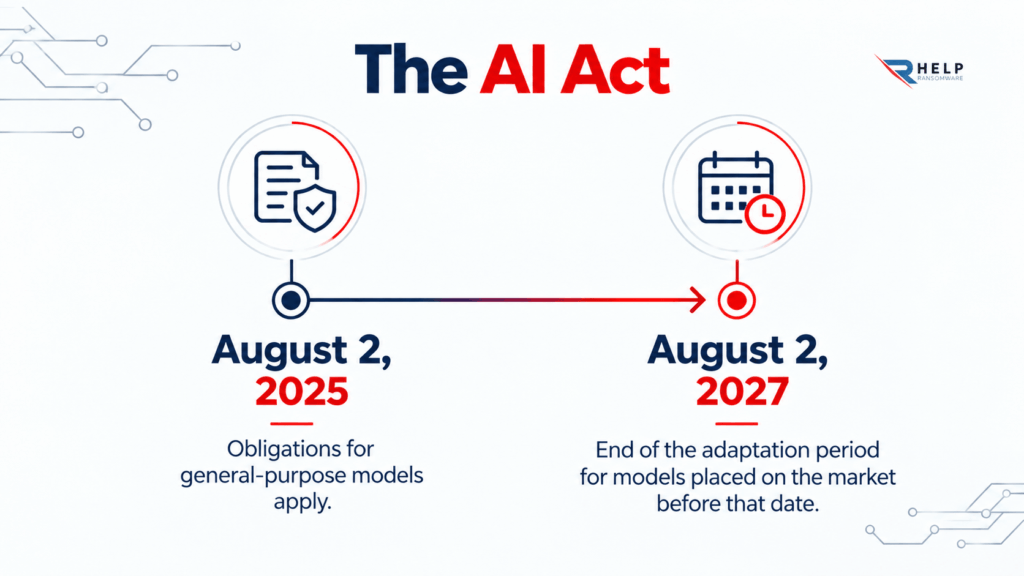
The implementation timetable is gradual, but that does not mean businesses can wait. Some obligations are already in force, while others require advance preparation, especially when they involve complex systems, external providers or high-risk processes.
AI literacy requirements began to apply on February 2, 2025. Since then, providers and deployers must seek to ensure that staff and other people operating AI systems on their behalf have a sufficient level of AI literacy, taking into account the context of use, the risks and the people affected.
From August 2, 2026 transparency obligations began to apply to certain systems, including tools that interact directly with people or generate synthetic content.
High-risk rules have later phases, so businesses should map now which systems may be covered and what documentation they will need.
How to Prepare Your Business for AI Act Compliance
Preparation should begin with an inventory of AI systems used across the organization, not only in IT. The greatest risks may lie in tools adopted by business teams or providers without centralized review.
Next, each system should be classified according to its purpose, the data it processes, its level of autonomy, its impact on people and its dependence on third parties. This classification makes it possible to prioritize which systems need urgent controls, which require contract review and which should be restricted or withdrawn.
The company must document every AI system, its owners, data, controls and incident response plan.
Finally, compliance must be connected to the cyberattack response plan. If an AI tool fails, leaks data or is manipulated, the company must be clear on who responds, what it communicates, what evidence it preserves and how it limits the impact.
Common Mistakes When Addressing the AI Act in Business
One of the most common mistakes is treating the AI Act as an isolated obligation, without connecting it to internal governance, risk management and human oversight.
The OECD AI Principles recommend that AI systems be transparent, robust, secure, accountable and overseen throughout their lifecycle, criteria that help turn compliance into an ongoing business practice.
The second mistake is assuming it only affects companies that develop AI. Many organizations do not train models, but they do integrate them into internal processes or use third-party services.
In those cases, they need to understand their role, review contracts and require sufficient information from the provider.
The third mistake is overlooking the reputational dimension. An AI-related incident may involve data leakage, discriminatory decisions, misleading content generation or deepfake fraud. Compliance is not only about avoiding penalties: it is also about protecting market trust.
Conclusion
The AI Act for businesses marks a profound shift: artificial intelligence is no longer just a technology tool; it becomes a system that must be governed, documented and protected.
Companies that already use AI need to act now to identify risks, classify systems, train teams and establish controls before the most demanding obligations become fully applicable.
Preparation should not be limited to an internal policy. It requires an inventory, risk analysis, provider review, cybersecurity measures, transparency, training and incident response. The sooner AI use is brought under control, the easier it will be to demonstrate compliance and reduce exposure.
At HelpRansomware, we help businesses strengthen their security, respond to digital incidents and prepare for risks that combine AI, data, cyberattacks and reputation. With the AI Act, getting ahead is the best way to turn a regulatory obligation into a trust advantage.
FAQ
Yes. It can apply to companies outside the EU if they offer AI systems on the European market or if the outputs of those systems are used in the European Union. An international company should therefore assess whether its products, services or processes affect users or customers in Europe.
The first step is to create an inventory of AI systems. The company needs to know which tools it uses, what they are used for, what data they process, who manages them, which provider is involved and what impact they may have on people or relevant decisions.
Yes. The AI Act requires providers and deployers to seek to ensure a sufficient level of AI literacy for staff and other people operating systems on their behalf. This means training proportionate to the context, the risk and the type of system used.
Not necessarily. The risk depends on the use case, the data entered, the impact of the output and the company’s role. Problems arise when tools are used without controls, with sensitive information or for decisions that require oversight, transparency or documentation.
No. The AI Act coexists with other rules, including data protection, cybersecurity, consumer protection, employment law and sector-specific regulation. A company may comply with part of the AI Act and still have additional obligations if the system processes personal data or affects regulated sectors.