
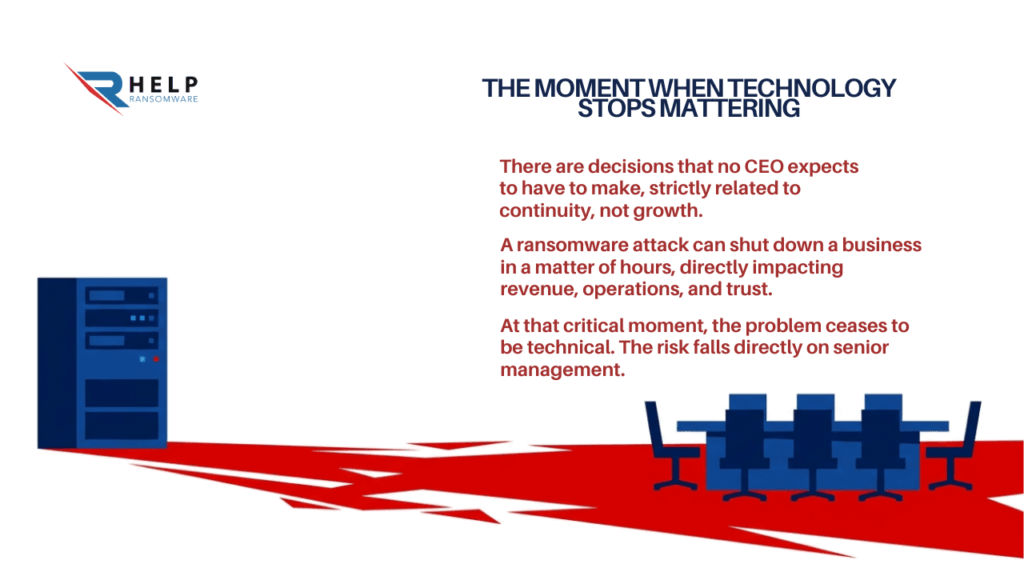
There are decisions no CEO expects to have to make, but they’re becoming increasingly common. They’re not about growth, expansion, or market share. They’re about continuity.
A ransomware attack is not a complex technical problem that stays within the IT department, but an event capable of stopping a company in a matter of hours, directly affecting revenue, operations and trust.
At that point, technology ceases to be the primary focus. What matters is the ability to make decisions under pressure, with incomplete information, and with immediate impact. Ransomware is not a technical problem that can be delegated; it is a risk that falls directly on management, and understanding this makes the difference between an organization that withstands it and one that is paralyzed.
The moment ransomware ceases to be technical
For years, cybersecurity has been treated as a secondary layer within the company. Something necessary, but not critical in strategic decision-making. That perception changes radically when an attack directly impacts operations.
When the attack has already progressed further than it seems
One of the most common mistakes is thinking that ransomware begins when the ransom note appears. In reality, that’s just the last step in a much larger process.
Attackers gain early access, move within the network, identify key assets, and prepare the environment to maximize their impact. Understanding the anatomy of a ransomware attack reveals that encryption is merely the visible phase of an intrusion that has been underway for some time.
By the time the attack becomes evident, the organization has already lost some control without realizing it, and in many cases has already suffered a previous impact that it had not detected.
Why IT can’t solve everything
At that point, many companies react by looking to the technical team. And it makes sense: they’re the ones with the knowledge to analyze and contain the situation.
But the problem is no longer just technical.
The IT team can explain what happened, which systems are affected, and what options are available. But they cannot decide whether to halt operations, report the incident, or what impact to assume.
Ransomware is not solved with technology, it is managed with decisions, and those decisions directly affect the business, the customers and the continuity of the company.
What a CEO really needs to understand about ransomware
It’s not about becoming a technical expert, but about understanding the real impact of the problem.

Expert Ransomware Removal
Our certified professionals have over 25 years of experience in ransomware removal, data recovery, and computer security.
Ransomware doesn’t enter where you expect.
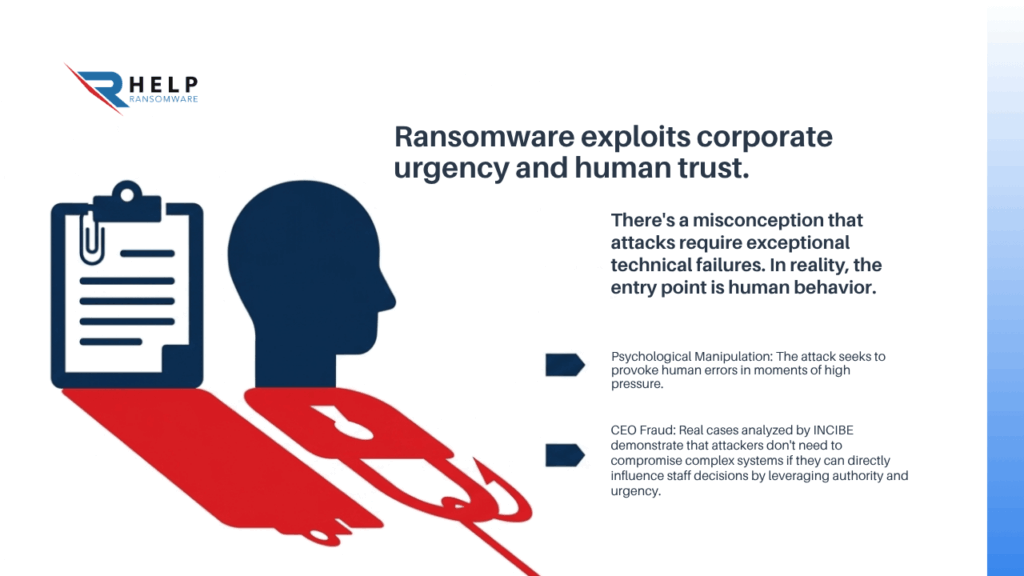
There’s a common misconception that attacks occur through complex technical vulnerabilities. However, in many cases the entry point is much simpler and relates to human behavior.
Attacks based on impersonation, urgency, or internal pressure are extremely effective. CEO fraud, analyzed by INCIBE in real-world cases of corporate deception, demonstrates how attackers don’t need to compromise systems if they can influence decisions.
This directly connects to psychological manipulation in ransomware, where the attack does not seek to break technology, but to provoke human errors in moments of pressure.
Ransomware works because it exploits urgency and trust, not just technical vulnerabilities.
The real impact isn’t encryption, it’s disruption.
The encryption is visible, but it’s not the most serious issue from a business perspective.
The real problem arises when the company stops operating normally. Processes grind to a halt, decisions are blocked, teams lack access to key tools, and operations can’t be carried out.
Even attempting to remove ransomware may not be enough if there is no clear strategy to maintain activity.
Ransomware doesn’t cause the most damage when it encrypts files, but when it paralyzes the business, and that impact multiplies over time.
Vulnerabilities are real and constant
The risk is neither theoretical nor distant. The vulnerabilities exist, are known, and are actively exploited.
Organizations like CISA constantly update alerts, such as their warning about actively exploited vulnerabilities, which shows that attackers are working on real and available flaws.
Even everyday tools can become entry points, as discussed in the malvertising ransomware initial access.
Ransomware doesn’t need complex systems or exceptional scenarios: it needs an opportunity and an unprepared organization.
The CEO’s role during an attack
When an attack occurs, the CEO stops managing growth and starts managing impact.
Making decisions under pressure and without full visibility
One of the most complex elements is that decisions must be made without having all the information. The full scope, the final impact, and the recovery time are unknown.
Even so, a decision must be made.
Stop operations, continue partially, communicate, or wait. Ransomware eliminates the margin for comfortable analysis and forces action in an environment of constant uncertainty, where every decision has immediate consequences.
Preparation versus improvisation
This is where the real difference between organizations occurs.
Companies that haven’t prepared for this scenario react haphazardly, accumulating errors, delays, and a greater impact. Those that have prepared act with greater control, clarity, and speed.
Working on advanced cybersecurity strategies involves defining roles, processes, and criteria before an attack occurs.
It’s not about reacting better, but about not having to improvise at the worst possible moment.
What sets a prepared CEO apart
It’s not the technical knowledge, nor the level of detail about the attack. It’s the way you understand the risk.

Expert Ransomware Removal
Our certified professionals have over 25 years of experience in ransomware removal, data recovery, and computer security.
Learn from real cases
Analyzing ransomware success stories reveals very clear patterns: the companies that respond best are not those that avoid the attack, but those that know how to manage it.
They have structure, leadership, and decision-making capacity.
When the attack occurs, they do not hesitate or block the organization: they execute what they had already defined.
Understanding that it is a structural risk
Ransomware is no longer exceptional. It’s recurrent, constantly evolving, and designed to maximize impact.
It does not depend on the size of the company, but on its exposure and preparation.
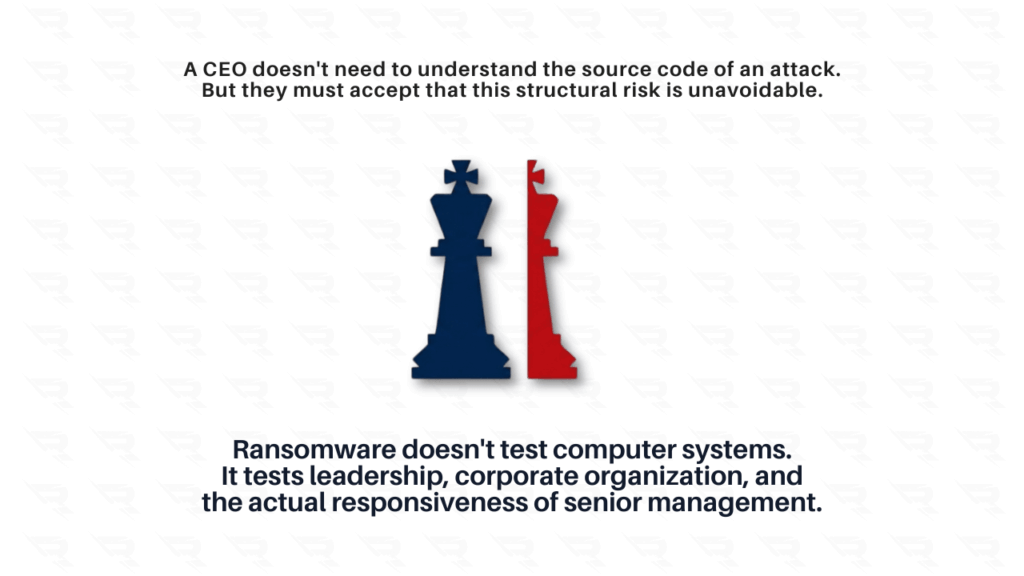
The CEO doesn’t need to know how the attack works, but he does need to accept that this risk is inevitable and that the difference lies in how it is managed.
Ransomware does not require technical knowledge from management, but it does require preparation.
At HelpRansomware, we work to help CEOs and management teams understand the real risk, make informed decisions, and reduce the impact when an attack occurs.
Conclusion
A CEO doesn’t need to understand the technical workings of ransomware.
But you do need to understand what happens when the company stops operating.
Because at that moment, the difference isn’t made by technology. It’s made by the ability to decide, coordinate, and maintain control.
Ransomware doesn’t test systems. It tests leadership, organization, and actual responsiveness.
Frequently Asked Questions (FAQ)
Does a CEO need technical knowledge?
Not exactly, you need to understand impact and decisions.
Who is leading the attack?
The management, with technical support.
Is encryption the biggest risk?
No, it’s business interruption.
Can a company be prepared?
Yes, with planning and simulation.
Why is it a management risk?
Because it directly affects business, continuity, and reputation.