For years, ransomware was considered a technical problem—something that affected systems, data, or access and could be resolved with technological measures. Today, that view is outdated.
Ransomware has evolved into a risk that directly impacts business continuity. It’s not just about encrypted files, but about a company’s actual ability to continue operating, meet commitments, and maintain the trust of its stakeholders.
Each attack tests more than just infrastructure: it exposes weaknesses in processes, decision-making, and preparedness. That’s why more and more organizations understand ransomware as a survival issue, not just a security one.
Ransomware is no longer an isolated incident
Thinking of ransomware as an isolated incident is one of the most common mistakes. The reality is that it’s part of a structured, planned attack model designed to have a real impact on businesses.
From technical problem to strategic risk
Today’s attacks are not just about encrypting data. They aim to disrupt operations, put pressure on the organization, and force urgent decisions. This completely changes the nature of the problem.
It no longer just affects the IT team. It affects management, operations, legal, communications, and, in many cases, the direct relationship with customers and suppliers.
Analyzing the different types of ransomware allows us to understand how these attacks have evolved into more complex models, where the objective is not only technical, but also strategic.
The real cost goes far beyond the rescue.
One of the most common mistakes is reducing the impact of ransomware to paying the ransom. However, that’s only one element of the problem.
When a company suffers an attack, it faces multiple simultaneous costs: operational disruption, loss of productivity, internal attrition, impact on customers, and reputational damage.
The true scope is reflected in the impact of ransomware on businesses, where the consequences extend far beyond the initial incident.

Expert Ransomware Removal
Our certified professionals have over 25 years of experience in ransomware removal, data recovery, and computer security.
Ransomware not only generates economic losses: it compromises the stability and credibility of the organization.
When the operation stops
The most critical moment of an attack is not just the encryption itself, but what happens afterward. That’s where a company’s resilience is truly measured.
Business interruption
When systems become unavailable, a company loses its ability to operate normally. It cannot access key information, manage internal processes, or serve customers.
This transforms the incident into a business continuity problem.
Many companies affected by ransomware did not fail due to a lack of technology, but because they were not prepared to manage a total or partial interruption of their activity.
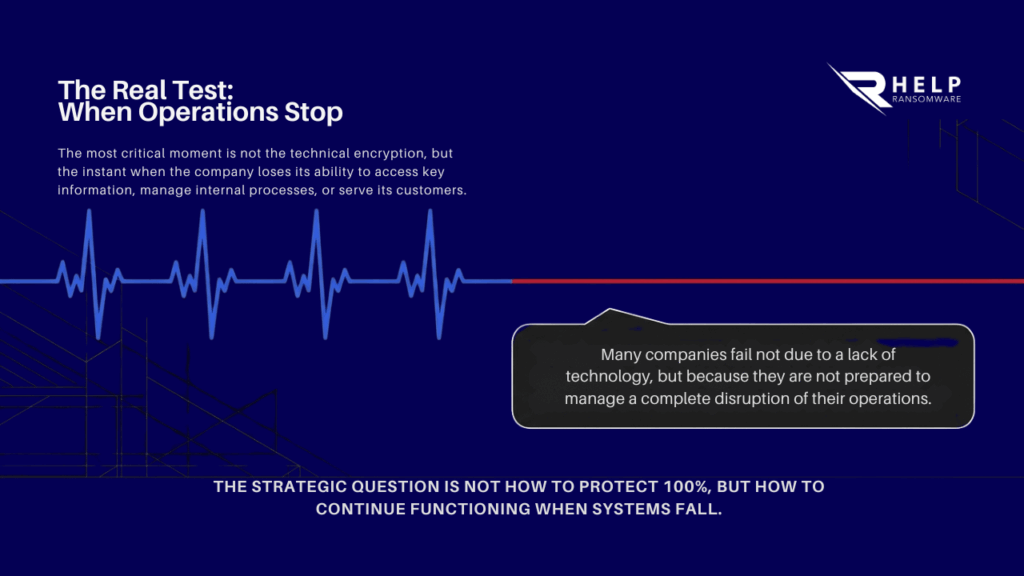
The question is not just how to protect ourselves, but how to keep functioning when something fails.
Making decisions under pressure changes everything.
One of the most complex aspects of an attack is decision-making in an emergency. In a matter of hours, the organization must decide how to act: contain, communicate, recover, negotiate.
Without prior preparation, these decisions are made under pressure, with incomplete information, and with a direct impact on the business.
In this scenario, the lack of preparation becomes a greater risk than the attack itself.
Reputation: the damage that isn’t immediately visible
The reputational impact of ransomware usually appears after the technical incident, but its effects can be much longer lasting.

Expert Ransomware Removal
Our certified professionals have over 25 years of experience in ransomware removal, data recovery, and computer security.
Trust as a strategic asset
Trust is one of the most important assets of any company. And also one of the most fragile.
When an attack occurs, customers, suppliers, and investors begin to question the organization’s ability to protect its information.
According to reputation management analyses such as those from ReputationUP, the perception of security can deteriorate rapidly, even when the incident is handled correctly.
Exposure of data and real consequences
Modern ransomware doesn’t just encrypt data, it also steals it. This introduces a completely different dimension to the problem.
Protecting company data becomes a critical element, as its exposure can have legal, regulatory, and commercial consequences.
Academic studies such as those from the Complutense University of Madrid show how digital incidents directly affect brand perception and consumer trust.
Reputational damage is not always immediate, but it is cumulative.
Detect before it’s too late
Many organizations focus their efforts on responding to the attack, but the real change lies in detecting it earlier.
Visibility versus reaction
A ransomware attack doesn’t happen instantaneously. It unfolds in several phases: access, reconnaissance, movement, and execution.
Working on ransomware detection allows for the identification of early signs, when it is still possible to act with greater leeway.
Detecting it earlier doesn’t eliminate the risk, but it does drastically reduce its impact.
Europe and regulatory pressure
In Europe, ransomware poses not only an operational risk but also a regulatory one. Companies must comply with increasingly stringent security and data protection regulations.
The analysis of ransomware in the European Union shows how this type of threat is driving regulatory changes that directly affect organizations.
This adds an extra layer of responsibility and requires a more strategic approach.
The necessary change of mindset
Ransomware can no longer be treated as an isolated technical problem. It requires a broader perspective, aligned with business strategy.
From cybersecurity to business resilience
Organizations must integrate cybersecurity as part of their operating model. Not as an expense, but as a key element to ensure business continuity.
Resilience is not about avoiding all attacks, but about knowing how to respond when they occur.
Prepare for the inevitable
Zero risk does not exist. All organizations are exposed to some degree.
The difference lies in preparation. In the ability to anticipate, detect, and respond in a structured way.
The companies that survive are not those that are not attacked, but those that know how to manage the impact.
If your company continues to view ransomware as a technical problem, it is underestimating its true impact.
At HelpRansomware we work to strengthen your detection, response and continuity capabilities , helping you to face these types of threats with a strategic approach.
Conclusion
Ransomware has ceased to be an isolated incident and has become a business risk.
It affects operations, reputation, and decision-making. It tests the organization’s structure and its ability to respond under pressure.
Companies that understand this reality do not eliminate risk, but they do improve their ability to withstand it.
Because today, ransomware is not just a security problem. It’s a business survival problem.
Frequently Asked Questions (FAQ)
Does ransomware only affect computer systems?
No. It impacts the entire organization , including operations, reputation, and management.
What is the biggest risk of an attack?
Business interruption and loss of trust.
Why does it affect reputation?
Because it undermines trust in the company’s ability to protect data.
Why is it a survival problem?
Because it can halt operations and affect business continuity.