For years, cybersecurity has been treated as a purely technical matter: installing tools, updating systems, and responding to incidents. However, the most advanced organizations have completely changed this way of thinking.
Today, cybersecurity is directly linked to business continuity, reputation, and the ability to make decisions in times of maximum pressure.
The companies that best manage risk are not those that never suffer attacks, but those that have learned to prepare for when the incident is already real.
Cybersecurity has moved out of the IT department
One of the most relevant changes is that cybersecurity is no longer managed solely from the technical area.
In many organizations, ransomware has ceased to be merely an IT problem and has become a business problem. When an attack paralyzes operations, locks down systems, or prevents access to critical data, the impact is not limited to IT; it affects the entire company.
That’s why more and more companies are incorporating this risk into their strategic decisions. It’s not just about protecting systems, but about understanding how an incident can affect revenue, customer relationships, or business continuity.
In this sense, understanding the impact of ransomware on companies allows us to properly assess the problem and stop seeing it as something purely technical.
What do the most prepared companies do differently?
The difference between a company that withstands an attack and one that is paralyzed is not usually a specific tool. It’s how well they prepared beforehand.
Understanding what’s at stake
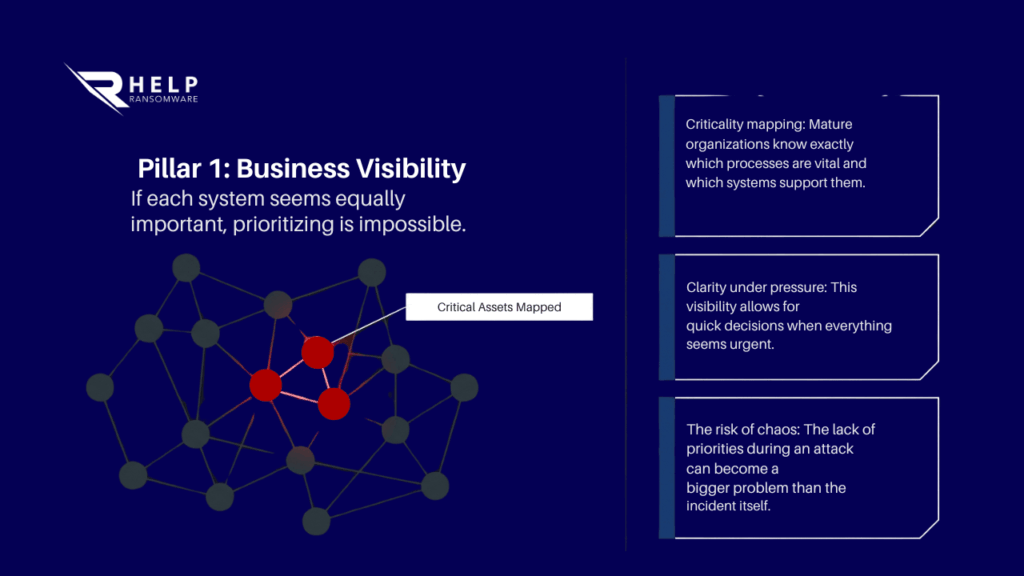
The most mature organizations focus not only on their infrastructure, but also on their business.
They know exactly which processes are critical, which systems support them, and what would happen if those systems stopped working. This level of clarity allows them to make quick decisions when everything seems urgent.
When a company lacks this visibility, every system seems equally important. And in a ransomware attack, that lack of prioritization can become a bigger problem than the incident itself.
Knowing how to act before you need to
One of the biggest mistakes during a cyberattack is improvising.
The best-prepared companies work on specific scenarios beforehand and define how to act in each case. This translates into structures such as a cyberattack response plan, which establishes who makes decisions, how the situation is communicated, and what actions are prioritized.
It’s not about having a document, but about having clarity. When every minute counts, knowing who decides and what to do drastically reduces the impact.
Train before it happens
Organizations that respond best to an attack do so not by intuition, but by practice.
They simulate real-world scenarios, test their teams, and detect flaws before the problem becomes a reality. These exercises involve not only technical professionals, but also management, communications, legal, and operations staff.
This allows us to understand how the organization behaves under pressure and improve ransomware crisis management in real-world situations.
You can see how this response is structured in ransomware crisis management, where the different roles involved are analyzed.

Expert Ransomware Removal
Our certified professionals have over 25 years of experience in ransomware removal, data recovery, and computer security.
Understanding how cybercriminals attack
Another key difference is that these companies focus not only on defending themselves, but also on understanding how attackers operate.
Many modern attacks don’t begin with a visible virus, but with compromised legitimate logins. Attackers use stolen credentials and system tools to operate without triggering alerts.
This type of behavior is part of many ransomware hackers’ tactics, and explains why some attacks go unnoticed for weeks.
Understanding this changes the way you protect yourself.
Prepare to contain, not just to prevent
The most advanced companies do not start from the idea that they can prevent all attacks.
They assume that, at some point, something will fail. That’s why they design their systems to limit the impact:
They separate environments, restrict access, protect critical assets, and prepare for recovery.
The goal is not only to prevent the attack, but to prevent it from becoming a full-blown crisis .
Where the real difference is made
When the attack begins, the situation changes completely.
There’s pressure, uncertainty, and decisions that directly impact the business. At that moment, the difference isn’t made by the tools, but by prior preparation.
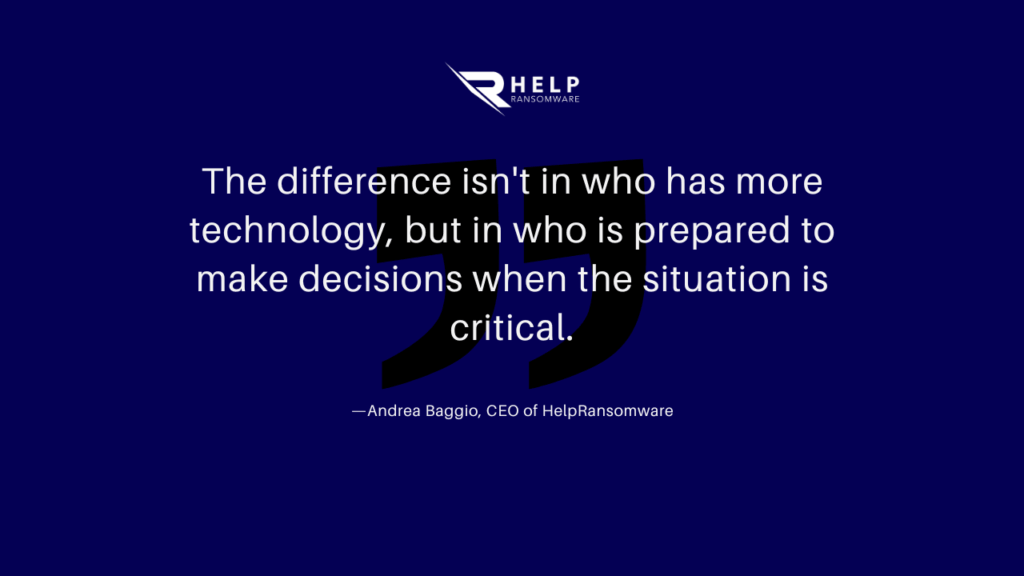
Andrea Baggio, CEO of HelpRansomware , explains :
“The difference is not in who has more technology, but in who is prepared to make decisions when the situation is already critical.”
Companies that have worked through these scenarios react more clearly. Those that haven’t often waste time trying to understand what’s happening.
The most common mistake
Many organizations continue to focus their efforts solely on preventing attacks.
However, the reality is that not all incidents can be prevented. In fact, European bodies have been insisting for years on the need to strengthen Europe’s cybersecurity as a key element for business stability.
The most advanced companies understand this and work on all phases: prevention, detection, response and recovery.
Therefore, ransomware protection is not a specific tool, but a way of addressing the risk.
If your company has not yet defined how it would act in the event of a real attack, the problem is not technical, it is strategic.
At HelpRansomware, we work to strengthen your digital resilience , help you understand where the real risks lie, and prepare your organization to act when every decision has an impact.
Conclusion
Advanced cybersecurity strategies are not built with technology alone.
They are built with preparation, clarity, and decision-making ability.
The companies that respond best are not those that have never been attacked, but those that know what to do when it happens.
In a scenario where attacks are becoming more frequent, the difference lies not in avoiding all incidents, but in how you respond when it is too late to prevent them .

Expert Ransomware Removal
Our certified professionals have over 25 years of experience in ransomware removal, data recovery, and computer security.
Frequently Asked Questions (FAQ)
What sets a prepared company apart?
Their ability to make quick decisions, coordinate teams, and act without improvising.
Are the tools sufficient?
No. Without strategy and preparation, the tools lose their effectiveness.
Why is a response plan key?
Because it prevents chaos and allows for quick action when an attack is already underway.
Who should be involved in cybersecurity?
The entire organization, not just the technical team.