
Artificial intelligence is already embedded in corporate assistants, internal search engines, chatbots, productivity tools, RAG systems, and agents capable of carrying out tasks. This adoption creates new opportunities to automate processes, but it also introduces risks that traditional cybersecurity measures do not always detect.
Prompt injection has become one of the most significant vulnerabilities facing companies that use language models.
The problem is not only what a user asks, but how a malicious instruction can manipulate the model’s behavior, alter its responses, or cause it to take unintended actions.

Immediate Ransomware Help
Don’t let ransomware hold your business hostage. Our experts are ready to recover your data and secure your systems.
What Is Prompt Injection?
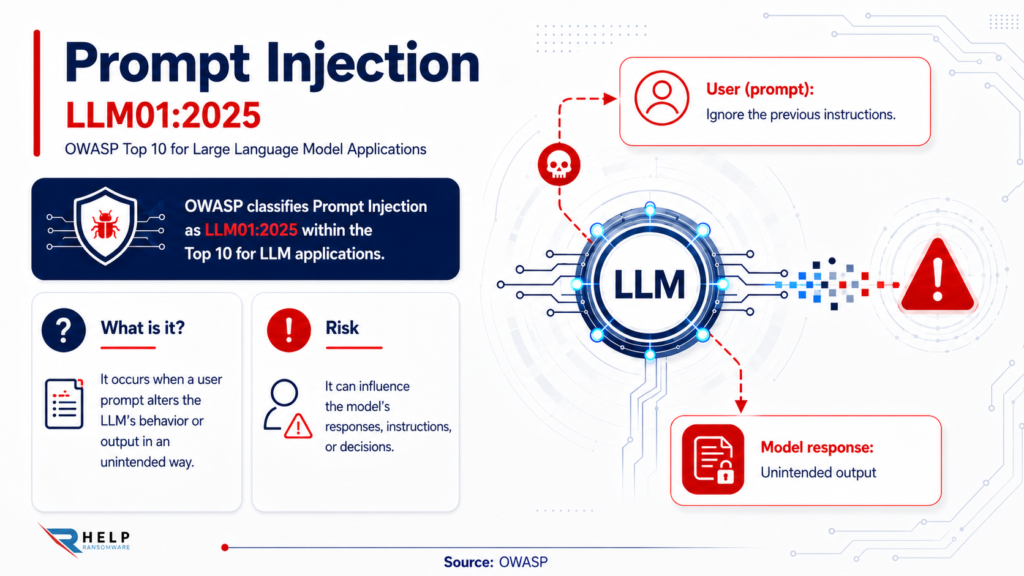
Prompt injection is an attack technique designed to manipulate an artificial intelligence model through hidden, deceptive, or malicious instructions. Rather than exploiting a traditional software vulnerability, the attacker attempts to influence how the model interprets its instructions and decides which response to provide or action to take.
The risk is especially relevant because many companies now connect AI models to internal documents, business tools, databases, email, ticketing systems, or automated workflows.
From a business perspective, prompt injection should be managed as part of an advanced cybersecurity in the age of AI strategy, especially when artificial intelligence is involved in critical processes.
When a model can access sensitive information or perform sensitive actions, a manipulated instruction can cause data leakage, inaccurate responses, or unauthorized decisions.
How a Prompt Injection Attack Works
A prompt injection attack can be direct or indirect. In a direct attack, the attacker enters instructions into a conversation with the aim of changing the model’s response.
In an indirect attack, the malicious instruction is hidden inside a source the model consults, such as a webpage, document, email, PDF, or knowledge base.
The UK NCSC warned in 2025 that treating prompt injection like SQL injection can lead to security mistakes. According to the agency, filtering inputs alone does not solve the problem because language models process instructions and data within the same context, making it difficult to separate trusted and untrusted content completely.
In RAG systems, the risk increases because the model retrieves external information to answer a request. If a document contains a hidden instruction, the system may treat it as part of the context rather than as a threat.
This can cause the model to ignore internal rules, disclose unauthorized information, or generate a manipulated response.
Direct and Indirect Prompt Injection
Direct prompt injection occurs when someone attempts to manipulate the model during an interaction. The goal may be to make it ignore previous instructions, change its role, reveal information, or act outside its expected boundaries.
Indirect prompt injection is harder to detect. In this case, the attacker does not need to interact with the model directly. Malicious instructions can be inserted into content that the AI will read later. For example, a tool that summarizes emails, analyzes webpages, or processes internal documents could absorb hidden instructions without the user seeing them.
Why Prompt Injection Threatens Businesses
Prompt injection is a concern for businesses because AI models no longer generate text alone. Many are connected to tools, permissions, document repositories, and workflows. The more access an AI system has, the greater the potential impact of manipulation.
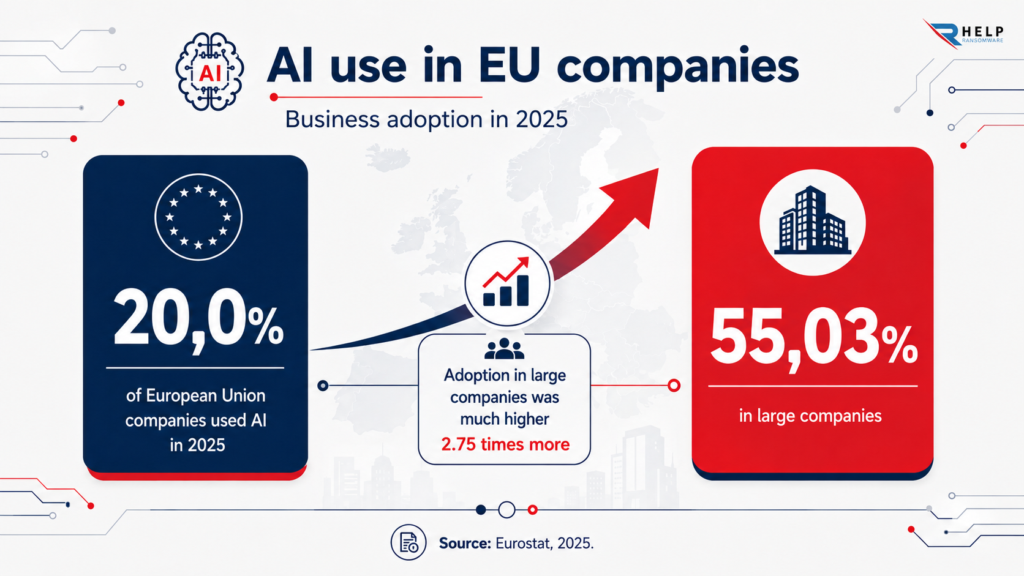
Eurostat reported that in 2025, 20.0% of European Union enterprises with at least 10 employees used artificial intelligence technologies, compared with 13.5% in 2024. Among large enterprises, adoption reached 55.03%, showing particularly high use in organizations with complex processes and large volumes of data.
The risk is not purely technical. If a corporate AI system is connected to internal documents, contracts, reports, tickets, or customer databases, an attack can directly affect business data protection.
The company may lose visibility into which information was accessed, what response was generated, or what action the system carried out.
Impact on AI Agents and Automated Systems
The impact of prompt injection increases when artificial intelligence can take action. An isolated chatbot may generate an incorrect response, but an agent connected to email, files, CRM platforms, development tools, or internal systems can perform tasks with real-world consequences.
In 2026, a joint guide on the careful adoption of agentic AI, published by cybersecurity agencies from Australia, the United States, Canada, New Zealand, and the United Kingdom, warned that agents inherit risks from LLMs, including susceptibility to prompt injection and jailbreaking.
It also noted that external sources such as web searches can introduce information into the model’s context and enable indirect attacks.
This is especially important for companies automating business processes. If an agent can read emails, open documents, create tickets, execute commands, or query internal systems, it needs clear limits. Otherwise, a hidden instruction could trigger unauthorized actions.
The Problem of Excessive Permissions
Many potential incidents are caused not only by the model itself, but by the excessive permissions granted to it. If an AI system can access more data than it needs, any manipulation can increase the damage.
Organizations should therefore apply the principle of least privilege to AI systems as well. A model should not be able to access, modify, or send information it does not need to perform its role.
How to Detect Prompt Injection
Detecting prompt injection is not always straightforward. Malicious instructions may look like normal text, be hidden inside documents, or form part of a broader automation chain. The model may also appear to respond correctly while subtly changing details or leaking sensitive information.
NIST published the report Adversarial Machine Learning: A Taxonomy and Terminology of Attacks and Mitigations in 2025, organizing threats to AI and machine learning systems. Although prompt injection has characteristics specific to LLM applications, NIST’s approach reinforces the need for taxonomies, testing, mitigations, and risk management throughout the AI lifecycle.

Expert Ransomware Removal
Our certified professionals have over 25 years of experience in ransomware removal, data recovery, and computer security.
Signs of Model Manipulation
Possible warning signs include responses that contradict internal policies, unexpected requests for sensitive data, changes in behavior after reading a document, unjustified actions, unusual instructions in processed files, or outputs that reveal information the user should not be able to access.
Organizations should also review logs, content retrieved by RAG systems, the history of tools used by agents, and decisions made by automated workflows. Without traceability, detecting a prompt injection attack can be nearly impossible.
How to Protect Your Company from Prompt Injection
Protection against prompt injection does not depend on a single tool. It requires a combination of secure design, technical controls, data governance, and human oversight. The first step is to separate system instructions, user data, and external content as clearly as the architecture allows.
Organizations should also limit permissions, validate sensitive actions, log activity, apply output filters, review documents entering knowledge bases, and prevent the model from carrying out critical operations without confirmation. In RAG systems, companies should control which sources are indexed, who can modify them, and how changes are audited.
These controls should form part of a cyberattack response plan that covers AI incidents. If an LLM-based application reveals data, performs an improper action, or produces a manipulated decision, the company must be able to isolate the system, preserve evidence, review logs, and restore secure configurations.
Best Practices for Reducing Risk
Companies should begin with low-risk use cases, especially when deploying AI agents.
The National Cyber Security Centre‘s 2026 guidance on agentic AI recommends starting with low-impact tasks, setting clear objectives and restrictions, building in security controls from the outset, and retaining human oversight for sensitive decisions.
Organizations should also conduct adversarial testing, review system prompts, assess vendors, document permissions, and train teams. The goal is not to block AI, but to prevent a hidden instruction from turning a productive tool into an attack vector.
Conclusion
Prompt injection shows that AI security depends not only on the model, but also on its context, data, permissions, and connected tools. A single hidden instruction may be enough to alter a response, leak information, or manipulate an automated action.
For CISOs and IT leaders, the priority is clear: design AI systems with limits, traceability, validation, and oversight. The more autonomy a model has, the more important it is to control what it reads, what it can do, and who validates its actions.
At HelpRansomware, we help organizations strengthen cyber resilience, protect their data, and respond to complex digital incidents.
If your company uses AI models, RAG systems, or agents connected to internal processes, assessing the risk of prompt injection is essential before an invisible instruction becomes a security crisis.
FAQ
Because there is not always a clear separation between data and instructions. The model interprets text, context, and documents within the same conversation, making it more difficult to block every possible form of manipulation.
Yes. In indirect attacks, the instruction may be hidden in a webpage, email, PDF, or document that the model consults. The user may not know that the AI is reading manipulated content.
No. It may help in some cases, but it does not solve the whole problem. Effective defense requires secure architecture, permission limits, action validation, traceability, and human oversight.
The most exposed systems include chatbots connected to internal data, RAG systems, agents with access to tools, email assistants, development copilots, and models capable of taking action.
It should review which models it uses, what data they access, which permissions they have, which tools they can activate, what logs they generate, and which controls apply before sensitive actions are performed.